---
title: "GLM and GLM-130B"
description: "From autoregressive blank infilling to bilingual large-model training, stability and INT4 serving."
---
> Documentation Index
> Fetch the complete documentation index at: https://latentlit.com/llms.txt
> Use this file to discover all available pages before exploring further.
# GLM and GLM-130B
import FocusCanvas from '../../../../components/FocusCanvas.astro';
import SourceFigure from '../../../../components/architectures/SourceFigure.astro';
- [Technical report](https://arxiv.org/pdf/2103.10360v2): Read the original research
- [Hugging Face](https://huggingface.co/zai-org/glm-10b): zai-org/glm-10b
Original GLM asks a useful question: can one network understand visible context in both directions, yet generate missing text one token at a time? Its answer is **autoregressive blank infilling**. GLM-130B carries that objective into a bilingual 130B model, where numerical stability and practical inference become central engineering problems.[^original][^130b]
This page studies two related releases, not one checkpoint. The Hugging Face resource above is **original GLM-10B**, not GLM-130B. The separate [GLM-130B technical report](https://arxiv.org/pdf/2210.02414v2) and [official release repository](https://github.com/zai-org/GLM-130B) document the 130B model and its download instructions.[^artifact][^release]
Study scope: original GLM report, March 2022 revision; GLM-130B report, October 2023 revision; selected released configurations and licenses. No checkpoint executed. Evidence checked October 10, 2026.
## Highlights
- **Bidirectional context, causal answers.** Observed text can interact freely, while missing spans are generated without seeing future target tokens.[^original]
- **An objective is not a permanent architecture.** Original GLM uses two learned position coordinates; GLM-130B switches to one-dimensional RoPE. Later causal GLM models should not inherit the original mask by name alone.[^original][^130b]
- **Scaling exposes numerical bottlenecks.** GLM-130B reports embedding-gradient spikes, failed normalization trials and a simple gradient shrink intervention.[^130b]
- **Quantization depends on the trained model.** Its weight distributions permit useful INT4 results, but the report does not establish that all models quantize equally well.[^130b]
## Model in numbers
| Dimension | Original GLM / GLM-10B | GLM-130B |
| --- | --- | --- |
| Parameters | Report experiments span 110M to 515M; the linked release is a separate 10B checkpoint.[^original][^artifact] | 130B dense bilingual model, not an expert model.[^130b] |
| Architecture | Released 10B config: 48 layers, width 4,096, 64 attention heads.[^artifact] | 70 layers, width 12,288, 96 heads, FFN inner width 32,768.[^release] |
| Training data | Original controlled experiments use BooksCorpus/Wikipedia; released 10B card names The Pile. A verified processed-token total for that artifact is not supplied here.[^original][^artifact] | Approximately 400B processed tokens, roughly balanced between English and Chinese.[^130b] |
| Training compute | Complete accelerator hours and FLOPs for the selected 10B artifact undisclosed in the inspected card. | Reported 60-day training window on 96 DGX-A100 nodes, eight 40GB GPUs each: 768 GPUs. This is not an exact useful GPU-hour ledger.[^130b] |
| Sequence contract | Linked 10B config: 1,024 positions, with task-dependent mask choices. Longer spans in the paper do not imply an unlimited released context.[^original][^artifact] | 2,048-token training sequence length; do not confuse weight quantization with longer context.[^130b][^release] |
## Blank infilling, step by step
Imagine a sentence with two missing spans. A conventional causal model cannot look to the right of a missing span. A masked encoder can look both ways, but its usual token-classification objective does not naturally generate an unknown-length answer. GLM keeps the useful parts of both contracts.[^original]
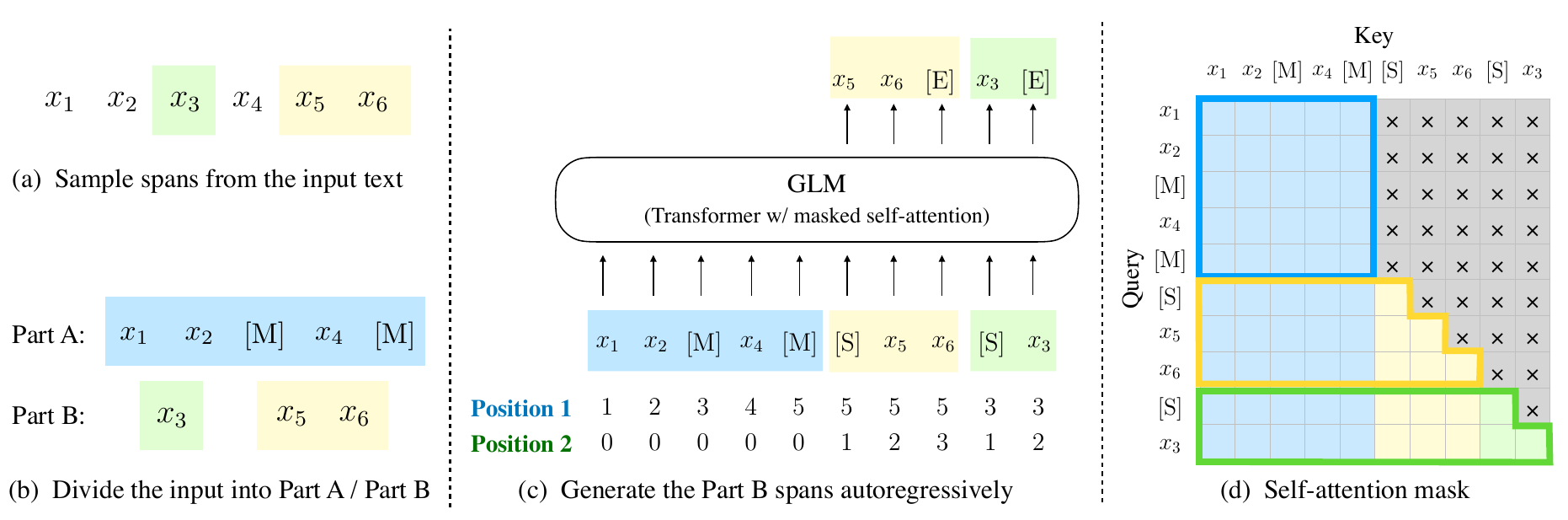
**Figure 1.** Bidirectional context with autoregressive missing spans. Du et al., original GLM report Figure 2, March 2022 revision; figure-only crop under [CC BY 4.0](https://creativecommons.org/licenses/by/4.0/).[^original]
**Image description:** Original GLM splits observed context and missing spans, assigns two position coordinates and uses a bidirectional-context causal-target attention mask.
Read [Figure 1](#figure-1) in four steps:[^original]
1. Sample spans and replace each with a single mask token. The remaining observed sequence is **Part A**.
2. Move the missing spans into **Part B**, shuffle their order, and mark each span's beginning and end.
3. Let Part A attend to all of Part A, but never to the hidden targets in Part B.
4. Let each Part B token attend to all of Part A and previously generated Part B tokens. It cannot see future target tokens, even inside its own span.
The report writes the span-order objective as:[^original]
$$
\mathbb{E}_{z\sim\mathcal{Z}_m}\!\left[\sum_{i=1}^{m}\log p_\theta\!\left(s_{z_i}\mid x_{\mathrm{corrupt}},s_{z_{\lt i}}\right)\right]
\tag{1}
$$
Here $z$ permutes the missing spans, and each span probability factorizes autoregressively over its tokens. The mask prevents label leakage; shuffling changes which recovered spans can provide context for other spans.[^original]
**Two positions solve two different questions.** The first coordinate identifies the span's mask location in the corrupted sequence. The second identifies progress within that span, with zero for observed Part A tokens. The original implementation uses learned position embeddings; this is not the same mechanism as modern rotary positions.[^original][^code]
Short spans are sampled with Poisson mean 3, covering about 15% of the input. Longer document blanks cover 50% to 100% of the input, teaching continuation; sentence-level blanks teach conditional generation. Changing the mask distribution changes the tasks the model practices.[^original]
## What the original ablation actually establishes
In Table 6, the 340M GLM-Large experiment averages 77.0 on SuperGLUE; removing span shuffling gives 68.5, and replacing cloze-style fine-tuning with classification gives 70.0. These are controlled experiments at that size and setting, not measurements of the linked 10B artifact.[^original]
There is a tradeoff, not universal dominance. Adding the document objective slightly reduces GLM-Large's SuperGLUE average from 77.0 to 75.7, while enabling useful language modeling. At equal model size, that multitask model does not match the causal GPT baseline's language modeling performance; the report's larger models narrow or reverse the gap. The objective's value depends on the downstream task and budget.[^original]
## Scaling the objective to GLM-130B
GLM-130B preserves short blank recovery and long continuation, but changes its positional and numerical design. It uses **one-dimensional RoPE and GeGLU**, not the original learned two-coordinate scheme. For short spans it discards the intra-span coordinate; for long end spans it continues ordinary positions beyond the visible prefix. The causal target mask already provides token-order constraints.[^130b]
Its training mixtures have two different denominators. About **95% of training tokens** are self-supervised and 5% come from 74 instruction-style datasets. Within the self-supervised recipe, 30% of sequences use short-span masks and 70% use a long end-span mask. Calling this entirely instruction-free pretraining would be incorrect.[^130b]
Normalization, precision and distributed training
The report describes more than 30 unsuccessful large-scale normalization trials before its adopted DeepNorm-style post-LN design. This rescales the residual path and initializes selected projections accordingly. It is a report-specific stability intervention, not evidence that ordinary pre-LN is always unstable.[^130b]
Training uses FP16 forward/backward operations with FP32 master weights and optimizer states. Four-way tensor parallelism, eight pipeline stages and data parallelism distribute the workload. The reported hardware/model FLOP utilization values are 43.3% and 32.5%, under the authors' definitions; they are not wall-clock percentages that can be transferred to a different kernel stack.[^130b]
The architecture ablation in Appendix B.3 is a **110M** test: perplexity falls from 24.58 to 22.95 with RoPE, and then to 22.31 with GeGLU. This supports a design choice at small scale, not a full 130B factorial ablation.[^130b]
## A small intervention for a large instability
The team noticed embedding-gradient spikes preceding loss spikes and NaNs. Rather than change the forward embeddings, it shrinks the gradient entering the embedding layer:[^130b]
$$
e'=\alpha e+(1-\alpha)\operatorname{stopgrad}(e),\qquad \alpha=0.1
\tag{2}
$$
The forward value remains $e$, but the derivative with respect to it is multiplied by 0.1. This is neither freezing embeddings nor shrinking their forward activations.[^130b]
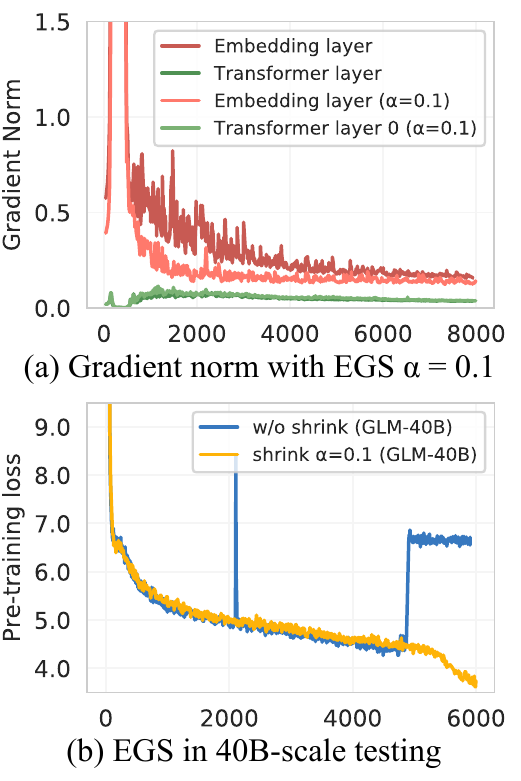
**Figure 2.** Shrink the gradient, not the embedding value. GLM-130B report Figure 4, October 2023 revision; both panels retained, under [CC BY 4.0](https://creativecommons.org/licenses/by/4.0/).[^130b]
**Image description:** Two GLM-130B report plots show reduced embedding gradient norms and a 40B test with fewer catastrophic loss spikes after embedding gradient shrink.
The lower plot in [Figure 2](#figure-2) is explicitly a **40B-scale test**. It strengthens the stability argument without isolating every cause of the final 130B run's success. The transferable lesson is to locate the numerical bottleneck before applying a global intervention.[^130b]
## Inference and INT4: what becomes smaller
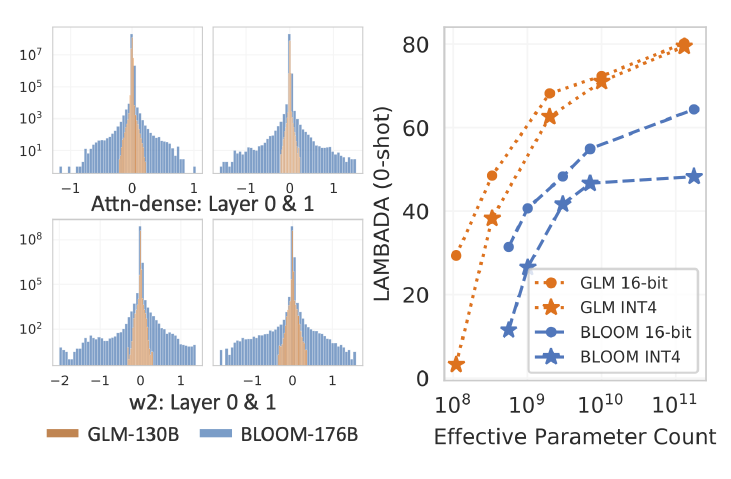
**Figure 3.** Weight distributions affect quantization loss. GLM-130B report Figure 5, October 2023 revision; complete histogram and accuracy panels under [CC BY 4.0](https://creativecommons.org/licenses/by/4.0/).[^130b]
**Image description:** GLM-130B and BLOOM weight histograms are paired with model-size versus LAMBADA accuracy curves for 16-bit and INT4 weights.
The disclosed path stores weights in INT4 and retains FP16 activations, dequantizing weights for FP16 computation. It is **weight-only quantization**, not an all-INT4 execution claim. The authors relate its small quality loss to relatively narrow, symmetric weight distributions; that is evidence about their model, not a universal architectural guarantee.[^130b]
Table 2 reports five-shot MMLU at 44.75 for FP16 and 44.80 for INT4, but zero-shot LAMBADA drops from 80.21 to 79.47. The latter is a 0.74 percentage-point drop. “Little loss” is more accurate than “lossless.”[^130b]
Reported weight memory is approximately 70GB, including overhead. Full runtime memory also includes KV cache, activations, buffers and parallel communication. The demonstrated four-RTX-3090 setup is tied to the authors' inference stack, not a hardware guarantee for any present-day backend.[^130b]
## Evidence limits and release boundaries
The 130B attribution study that compares bidirectional context and instruction-style pretraining uses an **English-only 10B model**, not retrained 130B variants. Some instruction-mixture gains are concentrated in similarity/coreference tasks and some tasks regress. Treat that as a mechanistic lead with a scale limitation.[^130b]
The official 130B weight license restricts use to noncommercial research, while its code is Apache 2.0. The inspected original GLM-10B card does not establish the same license grant. Public weights, code rights and report-figure rights are separate questions.[^release][^artifact]
Open reproduction questions include the exact training exposure for the selected original 10B artifact, complete compute accounting, and independent verification of INT4 behavior under a modern serving stack. Neither this study nor the inspected artifact check runs the model.
## Lessons
GLM is a useful reminder that **attention visibility, target order and positional representation are separate design decisions**. GLM-130B then shows that scaling an objective requires numerical and systems work, not just more parameters. Continue to [GLM-4](/architectures/models/glm-4/) to see a later causal, grouped-query checkpoint rather than assuming the original blank-infilling contract persists.
[^original]: Zhengxiao Du, Yujie Qian, Xiao Liu et al. [GLM: General Language Model Pretraining with Autoregressive Blank Infilling](https://arxiv.org/pdf/2103.10360v2), March 17, 2022 revision, ACL 2022. Sections 2 and 3, Figures 2 and 4, Tables 1 and 6.
[^130b]: Aohan Zeng, Xiao Liu, Zhengxiao Du et al. [GLM-130B: An Open Bilingual Pre-Trained Model](https://arxiv.org/pdf/2210.02414v2), October 25, 2023 revision, ICLR 2023. Sections 2 to 5; Figures 4 and 5; Table 2; Appendices B.3, B.8 and B.9.
[^artifact]: THUDM / Z.ai. [Original GLM-10B card](https://huggingface.co/zai-org/glm-10b) and [released configuration](https://huggingface.co/zai-org/glm-10b/blob/696788d4f82ac96b90823555f547d1e754839ff4/config.json), inspected October 10, 2026. The resource is GLM-10B, not GLM-130B.
[^code]: THUDM. [Original GLM implementation](https://github.com/THUDM/GLM/blob/4f61ed7237a3b0187f4d62062429348276a78c84/model/modeling_glm.py), inspected October 10, 2026. Targeted input, position and mask interfaces; not executed.
[^release]: Z.ai / THUDM. [GLM-130B official repository](https://github.com/zai-org/GLM-130B), [model configuration](https://github.com/zai-org/GLM-130B/blob/212215c54f8a9da2deed51455868305235664370/configs/model_glm_130b.sh), [weight license](https://github.com/zai-org/GLM-130B/blob/212215c54f8a9da2deed51455868305235664370/MODEL_LICENSE) and [code license](https://github.com/zai-org/GLM-130B/blob/212215c54f8a9da2deed51455868305235664370/LICENSE), inspected October 10, 2026.
Source: https://latentlit.com/architectures/models/glm/index.mdx