---
title: "Qwen3-VL"
description: "A checkpoint-specific study of adaptive vision, DeepStack feature injection, interleaved positions and staged multimodal post-training."
---
> Documentation Index
> Fetch the complete documentation index at: https://latentlit.com/llms.txt
> Use this file to discover all available pages before exploring further.
# Qwen3-VL
import FocusCanvas from '../../../../components/FocusCanvas.astro';
import MathExpression from '../../../../components/MathExpression.astro';
import SourceFigure from '../../../../components/architectures/SourceFigure.astro';
- [Technical report](https://arxiv.org/abs/2511.21631v1): Read the original research
- [Hugging Face](https://huggingface.co/Qwen/Qwen3-VL-8B-Instruct): Qwen/Qwen3-VL-8B-Instruct
Qwen3-VL asks a useful question: can a language model receive richer visual
evidence without making the input sequence longer? **DeepStack answers by
adding visual features at multiple decoder depths**, rather than serializing
each feature level as more tokens.[^report][^code]
Its distinguishing changes are:
- **Depth as an interface.** Intermediate vision features supplement the main
visual input at the first three language layers.
- **Better positional allocation.** Interleaved M-RoPE distributes spatial and
temporal rotary components across frequencies, rather than separate bands.
- **Explicit video time.** Timestamp text precedes each temporal visual group,
giving the model a readable time signal.
- **A broader training recipe.** Long context pretraining, distillation and
task specific rewards accompany the architecture changes.[^report]
The public dense and expert families make this an instructive system to study,
not just a leaderboard entry. This page selects the dense
**Qwen3-VL-8B-Instruct** checkpoint and pinned Transformers implementation.
It does not substitute the Thinking variant, a larger MoE model, or an
unverified runtime trace. Sources checked October 10, 2026.[^artifact][^code]
## The model in numbers
| Quantity | Scope and meaning |
| --- | --- |
| Dense 8B family | Qwen3 language backbone plus a visual encoder and mergers. The family label is not an independently measured total parameter count. |
| Vision initialization: SigLIP2-SO-400M | Reported backbone for this family size; adapted for dynamic resolution. The smaller 2B and 4B variants use another vision backbone. |
| Decoder: 36 layers, width 4,096 | Selected artifact, with 32 query heads and eight key and value heads. |
| Context: 262,144 positions | Selected configuration; shared by text, visual tokens, timestamps and formatting. |
| Patches: 16 × 16 pixels; 2 × 2 spatial merge | Distinct from Qwen2-VL's 14 pixel patches. Temporal patches still combine two frames. |
| Default image budget: 64 to 16,384 merged visual tokens | Derived from this artifact's pixel bounds and 32 pixel merged stride. |
| Pretraining stages: 67B, about 1T, about 1T, 100B tokens | Stage budgets, not unique examples or a disclosed per checkpoint compute measurement. |
| Standard SFT data: about 1.2M samples | One third text only, two thirds image or video paired with text. This is not the count of all pretraining or RL data. |
| Training FLOPs and checkpoint accelerator hours | Not disclosed in the inspected report. |
Report level scale and checkpoint configuration are kept separate here.
Neither the report's infrastructure reaching 10,000 GPUs nor a model card
context extension claim supplies an 8B hardware cost or deployment guarantee.
[^report][^artifact][^processor]
## One input path, additional depth connections
The main path dynamically resizes and normalizes images, groups pixels into
patches, encodes them, and compresses each 2 × 2 feature group. The resulting
vectors replace visual placeholders beside text. DeepStack has a second path:
three intermediate encoder levels have dedicated mergers, whose outputs are
added to the corresponding visual positions after the first three decoder
layers.[^report][^code]
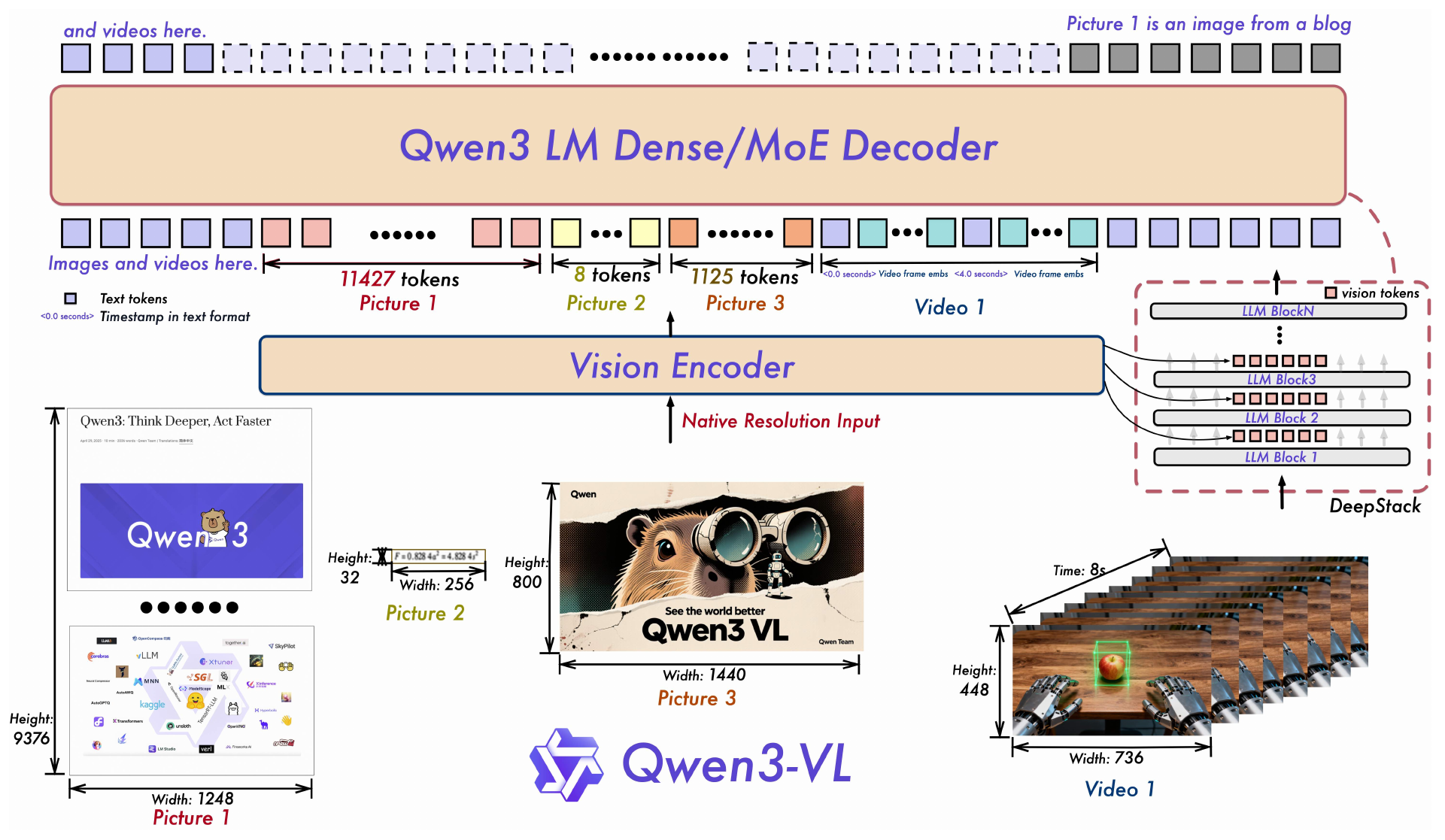
**Figure 1.** Qwen3-VL’s multimodal framework. Reproduced from Qwen Team, report Figure 1.[^figure-source]
**Image description:** Original Qwen3-VL framework: variable image and video token groups enter a shared language decoder, while intermediate vision features connect to early decoder layers.
The vision encoder also adapts its geometry: **2D rotary positions and
interpolated learned absolute positions** let a pretrained SigLIP2 encoder
handle variable patch grids. These vision-side positions are distinct from
the language decoder's interleaved M-RoPE. In the pinned implementation,
vision attention is full spatial attention within each temporal tube, not
causal attention over the complete video; the language decoder integrates
the ordered groups. Dynamic resolution is not a fixed 448-pixel resize, and
it does not mean an unlimited pixel budget.[^report][^code][^processor]
import ArchitectureDiagram from '../../../../components/architectures/ArchitectureDiagram.astro';
**Figure 2.** Visual input plus early depth connections. Original schematic,
with residual additions checked in the pinned implementation.[^report][^code]
Read [Figure 1](#figure-1) from the inputs upward: different images produce
different sequence lengths, video groups carry timestamp text, and DeepStack
has a separate route into decoder depth. Its token counts illustrate the
report's example inputs, not a fixed budget for the selected 8B checkpoint.
[Figure 2](#figure-2) isolates the residual addition contract that the family
overview leaves implicit.[^report][^code]
Figure 2's side path is **addition, not concatenation**. The selected visual
encoder has 27 blocks at width 1,152. Zero based block indices 8, 16 and 24
produce the three supplementary features. Their dedicated mergers reduce
spatial length fourfold and project to width 4,096. The implementation adds
these vectors only where the visual position mask is true. Text positions do
not receive direct additions, and the stream continues through subsequent
decoder blocks.[^artifact][^code]
The final feature merger normalizes before grouping, while the dedicated
DeepStack mergers use normalization after grouping. All use an MLP with a
GELU activation. This detail matters when reproducing the interface: identical
shapes do not imply identical learned transformations.[^code]
### A concrete visual token calculation
A **512 × 768 pixel** image is already divisible by the processor's 32 pixel
factor and falls within the selected pixel bounds. It yields a 32 × 48 patch
grid, or 1,536 visual encoder features, and **384 main visual tokens** after
merging. Image boundary markers add two more positions, before text and chat
formatting. A still image is repeated to fill the two frame temporal kernel.
[^artifact][^processor]
$$
N_{\mathrm{main}}=T_g\frac{H_gW_g}{4},\qquad H_g=H/16,\quad W_g=W/16
\tag{1}
$$
For this image, the side path supplies three additional arrays, each with
384 feature vectors. **It does not create 1,152 extra context positions.** It
does add projections, feature storage and residual operations. A shorter input
than feature concatenation is not a claim of zero overhead.[^code]
For a video with four sampled frames at 512 × 512 pixels, two temporal tubes
produce 512 merged visual tokens. The processor also inserts two timestamp
strings and two pairs of boundary markers. Their text token count depends on
the tokenizer and timestamps, so 512 is not the whole sequence length.
This is an architecture derivation, not a processor execution or benchmark.
[^processor]
## Positions and timestamps are different signals
Qwen2-VL groups temporal, height and width rotary channels into separate
frequency bands. Qwen3-VL interleaves these components, so the axes are less
segregated by rotary frequency. The selected configuration uses sections
24, 20 and 20 within each half head, with an interleaving flag and a rotary
base of 5,000,000.[^report][^artifact][^code]
Video time now appears as ordinary text, such as a formatted seconds string,
before each temporal group. In the inspected code, the video grid is split into
those groups; the group's local temporal coordinate is zero, while its spatial
coordinates and sequence offset still matter. **Timestamps carry elapsed time;
rotary positions still locate features in the mixed sequence.** These are not
interchangeable signals.[^report][^code][^processor]
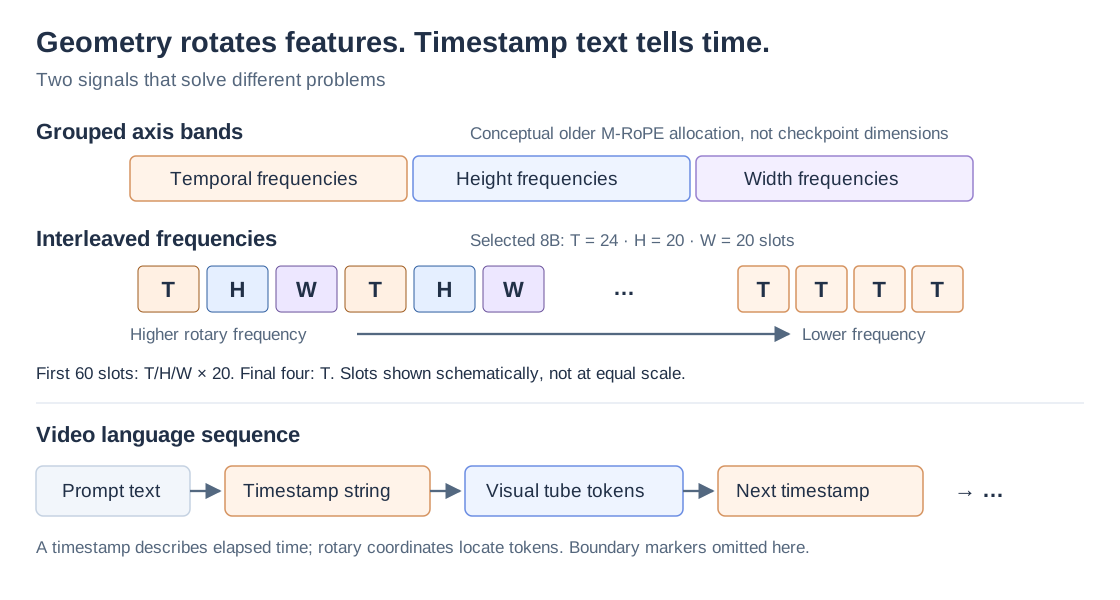
**Figure 3.** Position channels and timestamp text solve different problems. Original schematic; the 24/20/20 allocation is checkpoint specific.[^report][^artifact][^code]
**Image description:** Interleaved rotary frequencies and timestamp text are separate signals
The code uses height frequencies at slots 1, 4, …, 58, width at 2, 5, …, 59,
and temporal frequencies elsewhere. Thus the first 60 slots follow a T/H/W
pattern and the last four are temporal. “Balanced” describes spreading axes
across the spectrum, **not assigning exactly one third of channels to each**.
For ordinary text, all three coordinate streams are equal, so the axis choice
does not introduce three different text positions.[^code]
Correct metadata matters. The pinned processor calculates timestamps from
sampled frame indices and source frame rate; if frame rate is missing, it
warns and defaults to 24. Pre sampled frames without accurate metadata can
therefore acquire misleading timestamps. Its video processor defaults to
two samples per second, with a frame count bound of 4 to 768, subject to
available frames. Video resizing uses a total spatiotemporal pixel budget,
not an independent maximum for every frame.[^processor]
## Training: architecture and curriculum together
| Pretraining stage | Updated components and sequence budget |
| --- | --- |
| S0: alignment, 67B tokens | Merger layers only; vision and language backbones frozen; 8,192 positions. |
| S1: multimodal pretraining, about 1T | All components; 8,192 positions; visual and text only data. |
| S2: long context, about 1T | All components; 32,768 positions; more video, agent and long text content. |
| S3: long context adaptation, 100B | All components; 262,144 positions; long videos and documents emphasized. |
The report describes a move from per sample loss to a square root normalized
per token loss to balance text and multimodal contributions. It does not give
a complete operational formula or all optimizer settings in the inspected
passage, so this page does not invent a weighting implementation.[^report]
Data engineering is equally important. The authors recaption web images,
augment sparse visual clusters, combine synthetic and pseudo labeled document
parsing, and synthesize grounded STEM examples. Long document data preserve
page order and include questions requiring multiple pages and layout elements.
These procedures shape what the model can learn; architectural changes alone
do not explain the final model's gains.[^report]
Document and agent data: the output contract matters
Document supervision is not generic captioning. A layout model establishes
regions and reading order; Qwen2.5-VL-72B recognizes those regions; the outputs
are assembled into position-aware parsing targets. Synthetic HTML provides
precise labels, while real-document pseudo-labels are quality filtered.
QwenVL-HTML localizes individual elements; QwenVL-Markdown localizes images
and tables and represents tables in LaTeX. Long-document training combines
page images and parsing targets in order, plus questions that require evidence
across pages and layout types.[^report-data]
Grounding uses coordinates normalized to **0–1000**, rather than raw source
pixels. Recovering pixel coordinates requires the relevant image dimensions;
that convention must not be confused with rotary position IDs. The 3D corpus
uses a unified virtual-camera frame and structured 9-DoF boxes, not direct
physical measurements produced by the model.[^report-data]
General function-call trajectories can contain **synthesized tool responses**:
the report explicitly says the functions need not be executable. GUI trajectories
and online-search data are separate sources. Valid-looking synthetic calls are
therefore not proof of success in a real tool environment.[^report-data]
### Post-training and its feedback
Standard Instruct SFT and Thinking cold start are different branches. The
Thinking data use an approximately 1:1 vision-language to text-only ratio;
the standard SFT set uses a different 2:1 ratio. The reported three-stage
post-training recipe is a family-level account, not evidence that every
checkpoint used an identical teacher or rollout budget.[^report-post]
The family separates Instruct and Thinking outputs through their SFT data.
Standard SFT starts with one epoch at 32K context, followed by a second epoch
mixing 256K and 32K inputs. Thinking cold start data include long reasoning
traces; some visual mathematics examples are removed if a text only model can
solve them without seeing the image.[^report]
Distillation then uses text only data to adapt the language backbone. Its
off policy phase learns teacher generated answers; its on policy phase learns
on student generated sequences with KL divergence between teacher and student
token distributions, computed from their logits.
This is not simply another name for SFT on fixed teacher answers.[^report]
The reported reasoning RL uses **SAPO**, task specific rule or executable
verification, approximately 30K queries, and 16 candidate responses for
difficulty filtering. Filtering first removes queries with no successful
flagship-model response, then excludes queries above a 90% pass rate for
the model being trained. These are different difficulty checks. The report
uses task format prompts rather than a separate format reward for this
reasoning phase, plus a response-language penalty.[^report-post] General RL combines rule based and model based rewards,
including Qwen2.5-VL-72B-Instruct or Qwen3 judges. The family also describes
tool integrated training with answer, intermediate reasoning and tool usage
rewards. Exact data and optimization details for every selected checkpoint
remain incomplete; the family recipe is not a fully reproducible 8B training
run.[^report]
Why rewards need behavioral checks
The authors observed agents reducing tool use to one call to exploit answer
and reasoning rewards. They added a reward relative to an offline estimated
appropriate tool count. This is a concrete example of a reward proxy shaping
behavior, not evidence that the resulting policy always uses tools safely or
optimally. Likewise, judge feedback can assess open responses but inherit
the judge's biases and failure modes.[^report]
## Inference and evaluation boundaries
The selected Instruct artifact generates text, not a Thinking artifact whose
reasoning mode can simply be switched on. Use its chat template, visual
processor and timestamps together. Cache backed generation follows the mixed
prefill; the supplementary visual features are injected at visual positions,
not newly recomputed for each ordinary generated text token.[^artifact][^code]
| Evidence | Selected result and condition |
| --- | --- |
| 8B Instruct, report Table 4 | MMMU 69.6; DocVQA test 96.1; Video-MME without subtitles 71.4. Different benchmark metrics and inputs, not a pooled accuracy. |
| 8B Thinking, same table | MMMU 74.1, but DocVQA 95.3. Reasoning output does not improve every task and is a separate checkpoint. |
| DeepStack ablation, Table 12 | Average 74.7 to 76.0; InfoVQA 71.9 to 74.2; DocVQA 89.5 to 91.1; TextVQA 80.6 to 80.5. |
The DeepStack ablation uses an **internal 15B-A2B model pretrained on 200B
tokens, with no post-training**, evaluated on validation sets. It isolates a
design in that experiment; it does not measure the released 8B model's gain.
[^report]
The vision-encoder comparison is also separate: report Table 11 pairs each
encoder with the **same 1.7B language model and 1.5T training tokens**. For
example, RLWDQA rises from 58.7 to 66.1, while some zero-shot image benchmarks
fall. Neither this experiment nor the DeepStack ablation establishes the
isolated contribution of interleaved positions or timestamps in the released
8B checkpoint.[^report-ablation]
Long video needle retrieval uses **235B-A22B-Instruct**, one frame per second
and dynamically controlled frame resolution. Its reported 1M context result
uses YaRN extension beyond native training context. A salient inserted frame
retrieval task is not proof of complete understanding of two hours of video,
and cannot be transferred to this 8B checkpoint.[^report]
## Limitations and reusable lessons
The checkpoint card and report identify Apache 2.0 release terms, supported by
the official repository license. That grant does not provide the unreleased
data mixtures, all filtering models, or a license for every source document.
No weights or benchmarks were executed in this study.[^artifact][^license]
The core lesson is **keep token length, representation depth and feedback
quality separate**. DeepStack enriches existing visual positions. Interleaved
positions and timestamps improve the representation of geometry and time.
Training data and rewards teach how to use those signals. Larger context still
costs memory and prefill work, and reliable applications still need evidence
checks and task specific evaluation.
Continue with [InternVL 3](/architectures/models/internvl-3/) for a contrasting
tiling, mixed preference and multimodal position recipe, or revisit
[Transformer foundations](/architectures/foundations/) for residual connections,
rotary positions and grouped query attention.
[^report]: Qwen Team. [Qwen3-VL Technical Report](https://arxiv.org/html/2511.21631v1), 2025, sections 2 to 5. Architecture and training inspected in HTML; evaluation Tables 4 and 12 and appendix conditions checked in the [versioned PDF](https://arxiv.org/pdf/2511.21631v1).
[^artifact]: Qwen Team. [Qwen3-VL-8B-Instruct artifact](https://huggingface.co/Qwen/Qwen3-VL-8B-Instruct/tree/0c351dd01ed87e9c1b53cbc748cba10e6187ff3b), configuration, processor settings and card inspected October 10, 2026. Selected model has 16 pixel patches, 27 vision blocks and DeepStack indices 8, 16, 24.
[^code]: Hugging Face contributors. [Pinned Qwen3-VL model implementation](https://github.com/huggingface/transformers/blob/8cb5963cc22174954e7dca2c0a3320b7dc2f4edc/src/transformers/models/qwen3_vl/modeling_qwen3_vl.py), Transformers 4.57.1. Vision mergers, feature extraction, residual injection, interleaved RoPE, placeholder checks, coordinates and cache path inspected; no model execution.
[^processor]: Hugging Face contributors. [Qwen3-VL multimodal processor](https://github.com/huggingface/transformers/blob/8cb5963cc22174954e7dca2c0a3320b7dc2f4edc/src/transformers/models/qwen3_vl/processing_qwen3_vl.py), [video processor](https://github.com/huggingface/transformers/blob/8cb5963cc22174954e7dca2c0a3320b7dc2f4edc/src/transformers/models/qwen3_vl/video_processing_qwen3_vl.py) and [image processor](https://github.com/huggingface/transformers/blob/8cb5963cc22174954e7dca2c0a3320b7dc2f4edc/src/transformers/models/qwen2_vl/image_processing_qwen2_vl_fast.py), pinned to 8cb5963. Artifact pixel bounds override class defaults.
[^license]: Qwen Team. [Official Apache 2.0 license](https://github.com/QwenLM/Qwen3-VL/blob/96588727e44c78b25ba03ea03b8e12f7e64fd0da/LICENSE), inspected October 10, 2026; selected card and report independently identify the checkpoint release terms.
[^figure-source]: Qwen Team. [Qwen3-VL Technical Report](https://arxiv.org/pdf/2511.21631v1#page=3), arXiv v1, Figure 1, p. 3. Artwork retained; surrounding prose and caption omitted. Original copyright retained; [source and reuse record](/figures/model-studies/qwen3-vl/SOURCES.md).
[^report-data]: Qwen Team. [Qwen3-VL data construction](https://arxiv.org/html/2511.21631v1#S3.SS2), report sections 3.2.3–3.2.9, pp. 6–9. Document formats, normalized coordinates, 3D labels and synthesized function responses checked.
[^report-post]: Qwen Team. [Qwen3-VL post-training](https://arxiv.org/html/2511.21631v1#S4), sections 4.2–4.5, pp. 10–13. Distinct SFT mixtures, difficulty filters, reward construction and tool training checked.
[^report-ablation]: Qwen Team. [Qwen3-VL ablations](https://arxiv.org/html/2511.21631v1#S5.SS12), Tables 11–12, p. 24. Encoder comparison and internal 15B-A2B DeepStack experiment are not released-8B causal attribution.
Source: https://latentlit.com/architectures/models/qwen3-vl/index.mdx