All clip transcripts
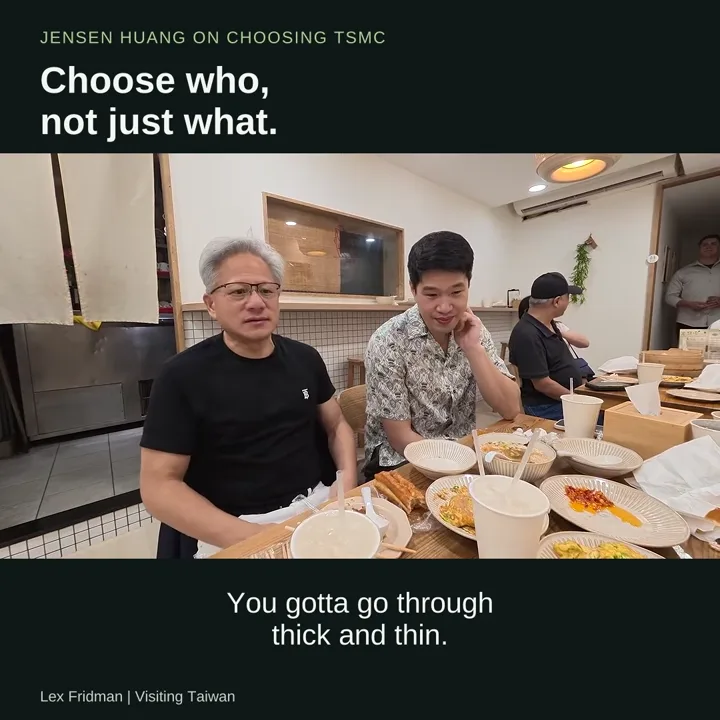
Choose who, not just what.
You gotta go through thick and thin. There are a lot of unpredictable things in the future. And it's because you're building a chip together. It's a foundry. It's not exactly like buying something off the shelf. You're building a chip together, and it's really hard to build chips. So it's impossible to know all the details. It's impossible to make all the decisions up front. You really are choosing not... what to buy, but who to work with.
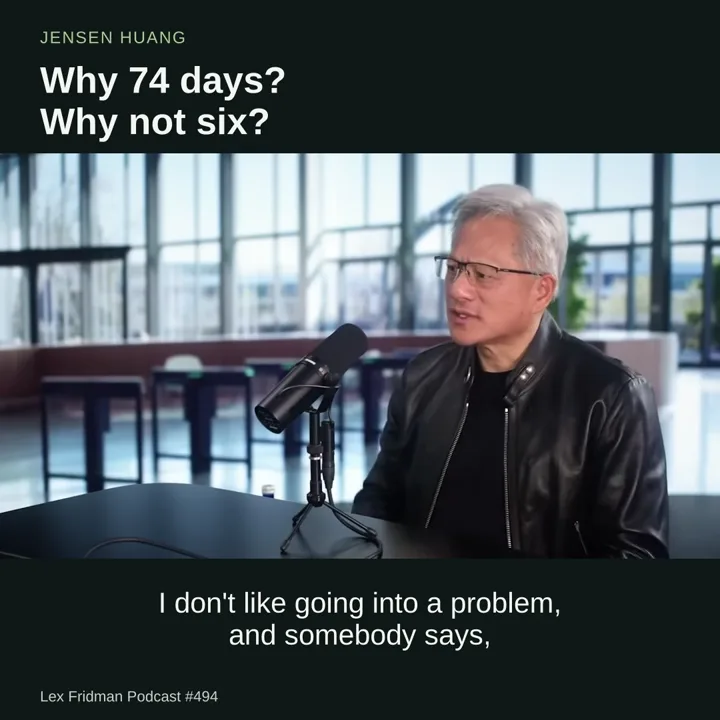
Original source · 1:24:47Why 74 days? Why not six?
I don't like going into a problem, and somebody says, It takes 74 days to do this today. And we can do it for you in 72 days. I'd rather strip it all back to zero First of all, explain to me why 74 days in the first place. Let's think about what's possible today. And if I were to build it completely from scratch, How long would it take? Oftentimes, you'd be surprised. It might come to six days. Now, the rest of the six days, the 74, could be very well reasoned, and compromises, cost reductions, and all kinds of different things. But at least you know what they are. Now that you know that six days is possible, then the conversation from 74 to six, surprisingly much more effective.
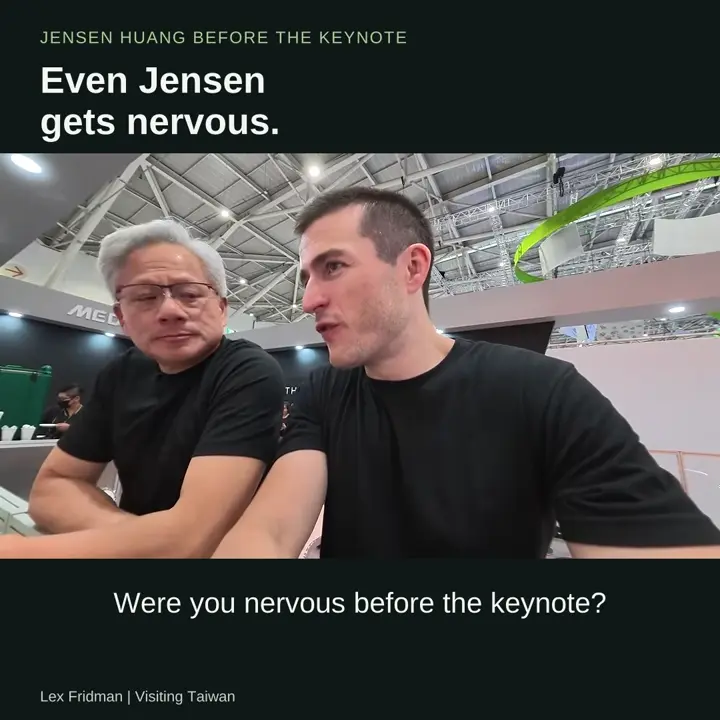
Original source · 58:40Even Jensen gets nervous.
Were you nervous before the keynote? The whole world watching. I was super nervous, but I’m always nervous. Every public speaking, doesn’t matter what it is. Keeps you sharp? Yeah, well, I don’t take it for granted. I want to do a good job. Because everything comes together at such a last moment, it’s hard to practice at all, and we don’t. And so I don’t know exactly all the words that I’m gonna say. And there’s no teleprompter.
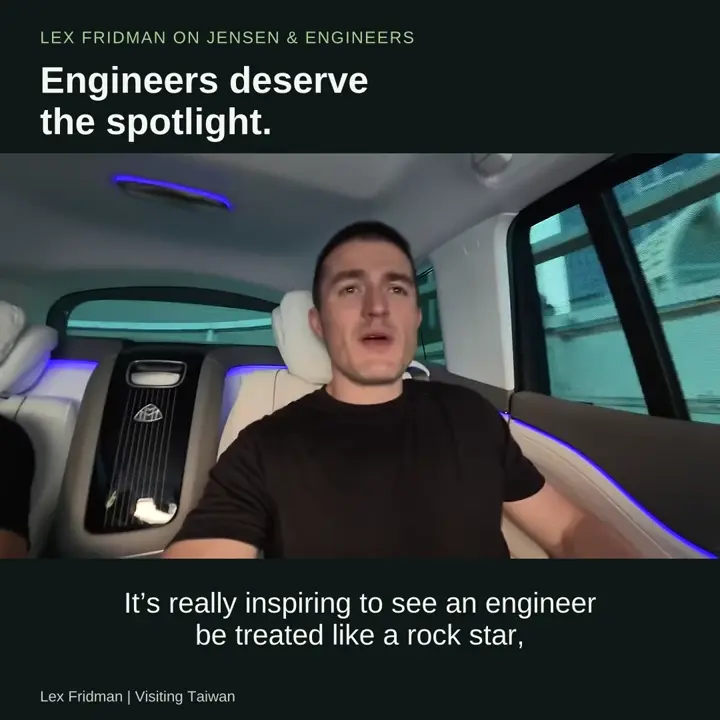
Original source · 9:21Engineers deserve the spotlight.
It’s really inspiring to see an engineer be treated like a rock star, because engineers build the world, and they don’t often get the love I think they deserve. And you’re an inspiration to thousands, millions of young kids who will be like, “Okay, I’m gonna... I’m gonna be an engineer too.” That’s right. Exactly.
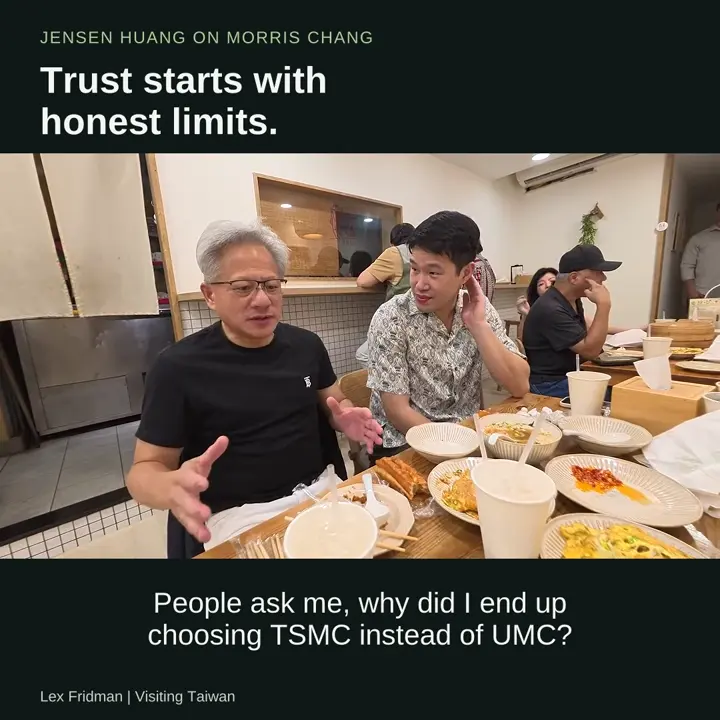
Original source · 13:28Trust starts with honest limits.
People ask me, why did I end up choosing TSMC instead of UMC? And the reason was because I like both companies equally. They’re both excellent companies. But the thing that I really liked about TSMC was, there were a lot of things that I said that Morris said, “We can’t do that.” And I’ll say, “What about that?” “We can’t do that.” There’s a lot of things that they just can’t do. And so he had a philosophy about his business, and he has a set of core values that he cares about. And he spent all his time talking about corporate governance and integrity, partnership and thinking long term. And not once did he talk about anything else. And he said one thing. He said, “Jensen, if we were to work together, I promise you we would jump through hoops for you.” And for the whole time, 30 years, they’ve been jumping through hoops for us. Yeah. He kept his word. The core values of that company are really, really strong. It was there from the very beginning.
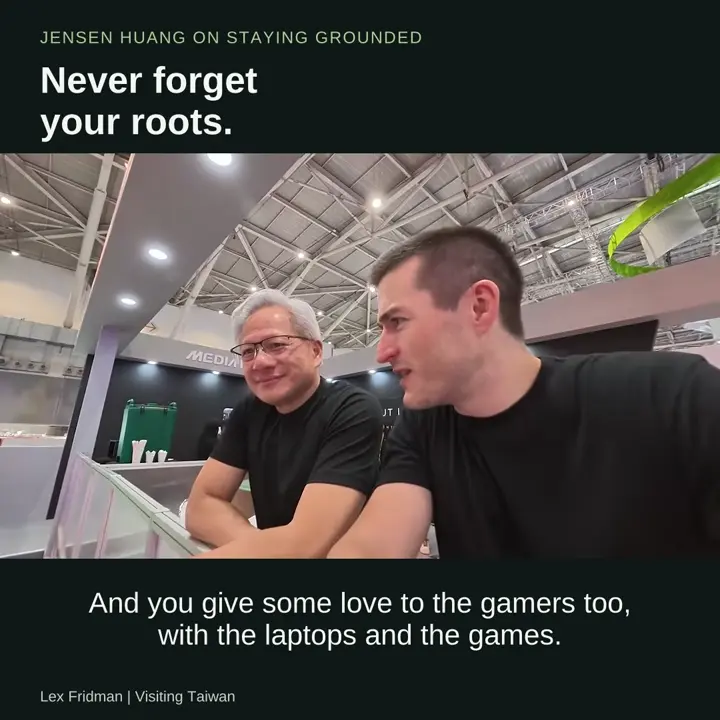
Original source · 1:23:40Never forget your roots.
And you give some love to the gamers too, with the laptops and the games. Oh, I love the gamers. That’s where we all begin. You know, don’t forget your roots. No matter how high you are, don’t let your feet leave the ground.
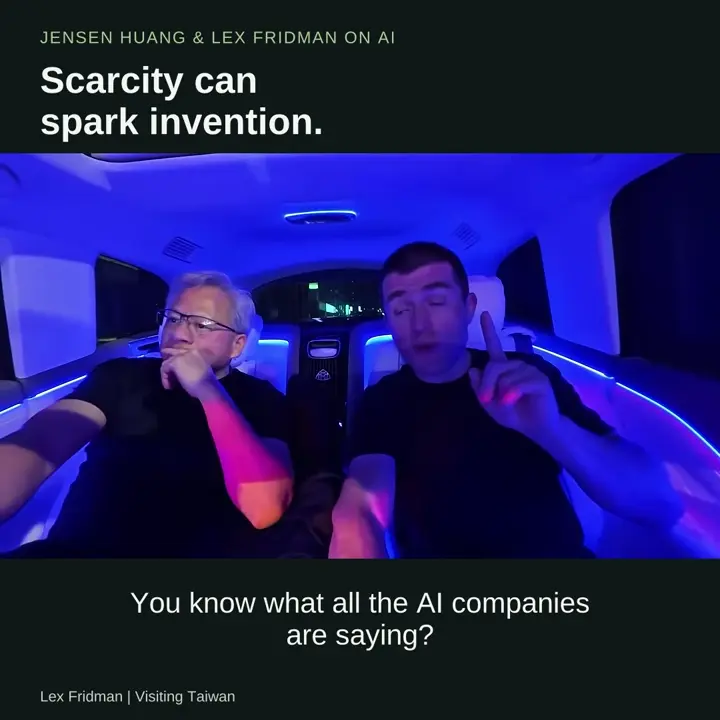
Original source · 10:36Scarcity can spark invention.
You know what all the AI companies are saying? They’re compute starved. More compute. Yeah, but somehow, while they’re compute starved, it forces them to come up with these incredible architectures that are so efficient. Constraints is the kind of mother of invention. Right. Scarcity.
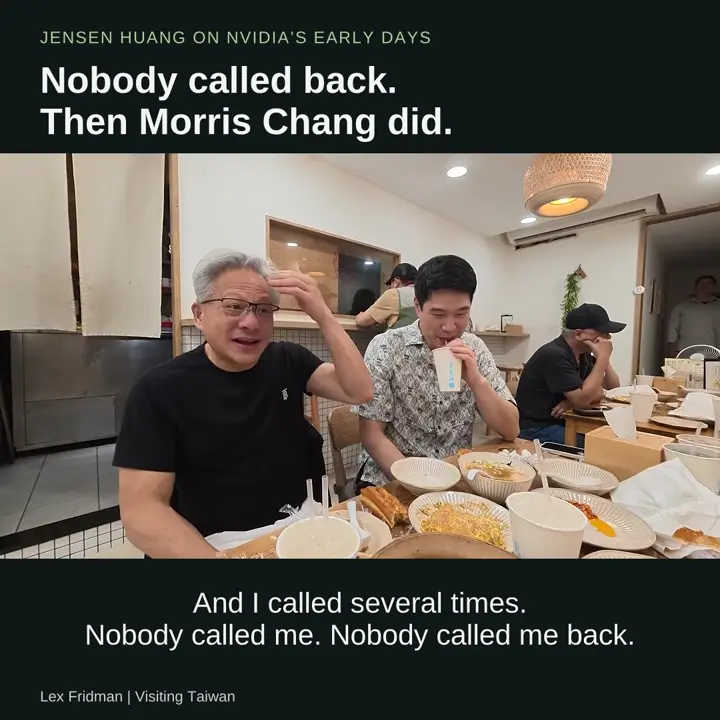
Original source · 32:50Nobody called back. Then Morris Chang did.
And I called several times. Nobody called me. Nobody called me back. And so I finally wrote a letter to Morris. I wrote a long letter and sent it to him. Didn’t hear anything for a long time, and then one day, it was around maybe 6:00 or so, maybe 6:30 or so. This person calls and says, “This is Morris Chang from TSMC.” Meanwhile, everybody outside my office was playing video games. And they’re all laughing and screaming. I think they were playing PlayStation, the first PlayStation at the time. Everybody’s laughing and screaming. I said, “Hey, guys, shut up. It’s Morris Chang.” You know, called me back. And so I was so happy that a founder would actually call us back. Because, hey, maybe we won’t have to die.
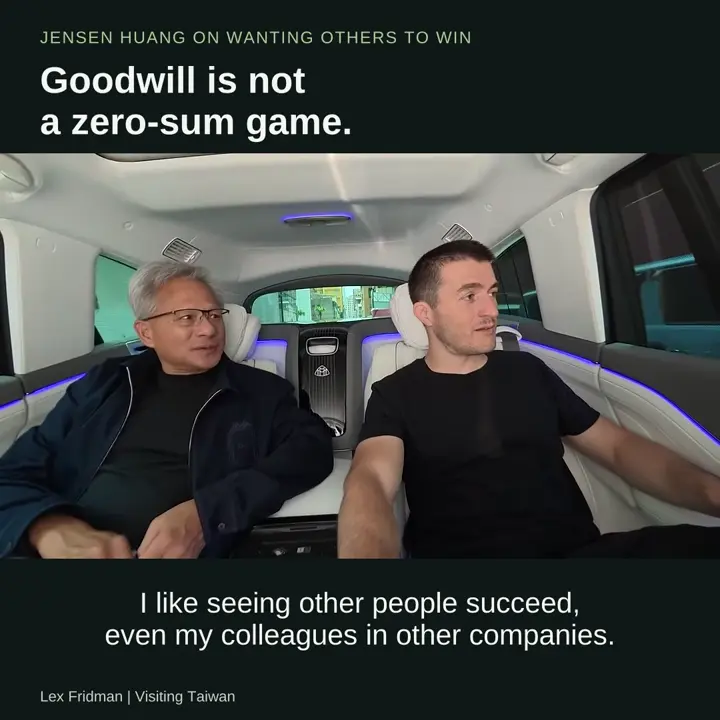
Original source · 1:21:58Goodwill is not a zero-sum game.
I like seeing other people succeed, even my colleagues in other companies. It's a funny thing how the world works. If you just celebrate others and you want them to succeed, somehow you succeed more. For example, 43,000 employees at NVIDIA want me to succeed, literally. You know what I’m saying? And you want each of them to succeed. Exactly. I mean, I’ve seen you. You want people at other companies to succeed. And they want me to succeed. And there’s a ripple effect to the whole thing. Yeah, exactly. Goodwill is not a zero-sum game. It’s not limited by physics.
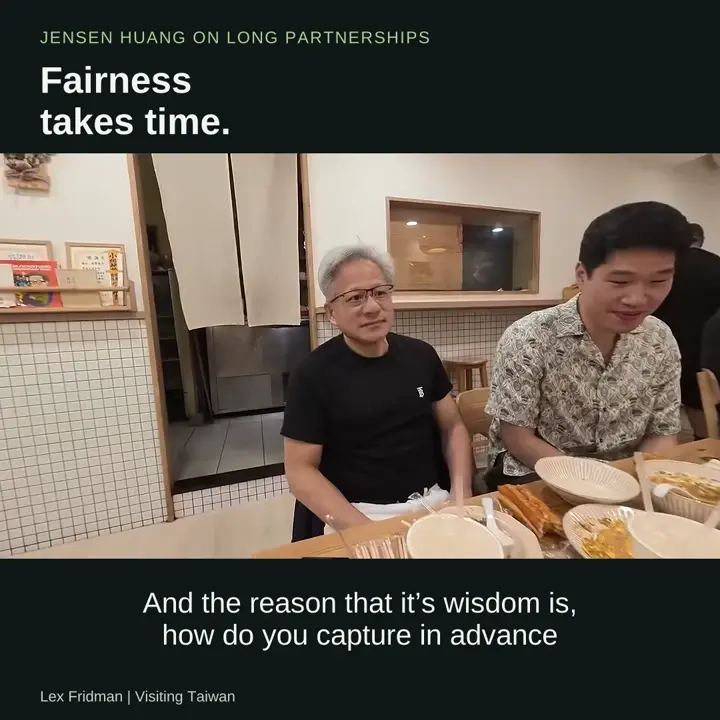
Original source · 43:50Fairness takes time.
And the reason that it’s wisdom is, how do you capture in advance all the unknowns in a relationship? It’s like writing up an ironclad prenup or something. The problem is, the more specific you want it to become, the more brittle that relationship is going to be. And so I had the wisdom of keeping it nice and loose, discover our way there. Rough justice. We use this phrase, “rough justice.” Sometimes they win, sometimes I win. Sometimes I like how things worked out better than they did. Sometimes they like it better than I did. Over the course of time, it all works out.
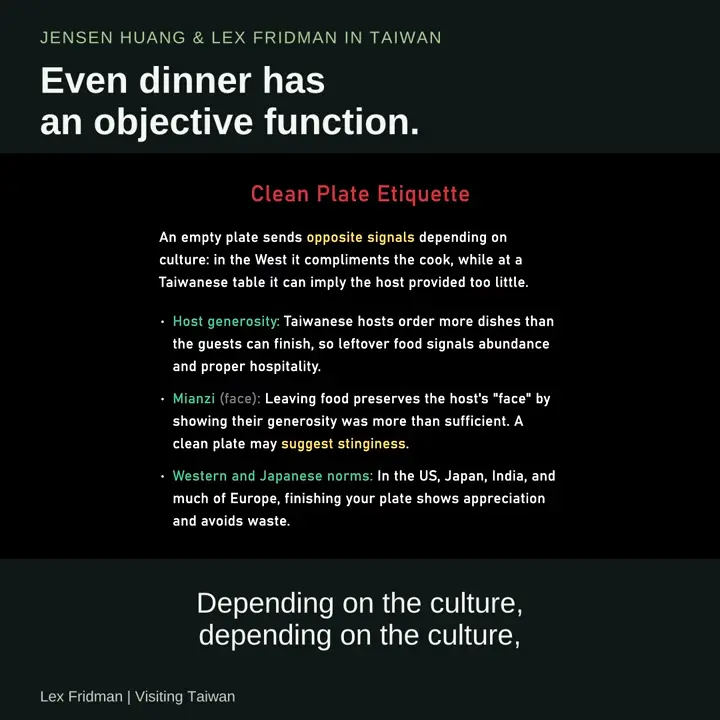
Original source · 1:25:51Even dinner has an objective function.
Depending on the culture, depending on the culture, if you don’t eat everything, it’s rude. And in some cultures, if you eat everything, it’s rude. So you’re either competing for their generosity or competing for your appreciation for their food. And they’re both important, but depending on culture, one’s more important than the other. So in this culture, their generosity is more important than your appreciation for the food. That’s a kind of optimization problem. Yeah. So you just gotta know which country you’re in. You gotta figure out the objective function based on country. That’s right. Conditional country.
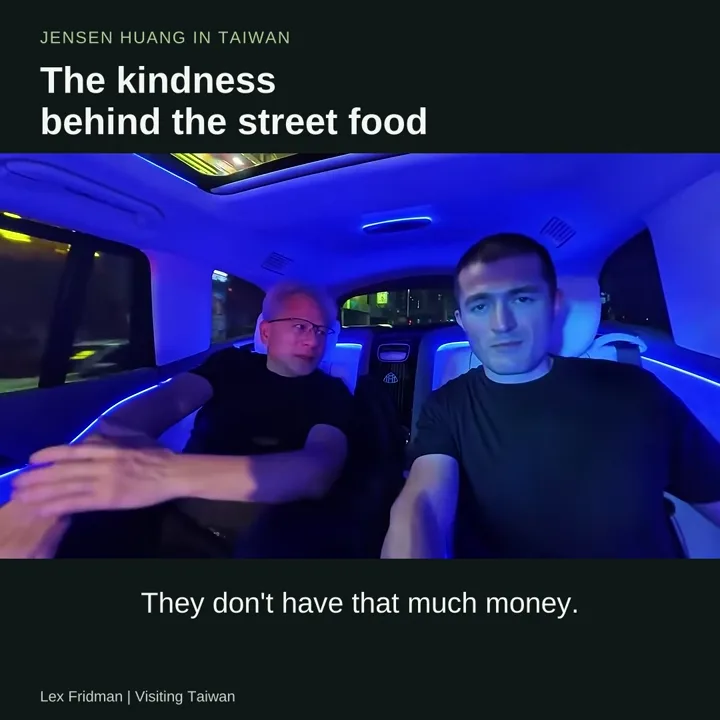
Original source · 58:26The kindness behind the street food
Everybody's working hard for a living, and they're working so hard, and they still want to share a little something with you. They don't have that much money. Their profit margin on that thing must be a dime each. They gave me all their profit, right? Just to be kind. It's the Taiwanese way, and it's nice to watch these people, their craft.
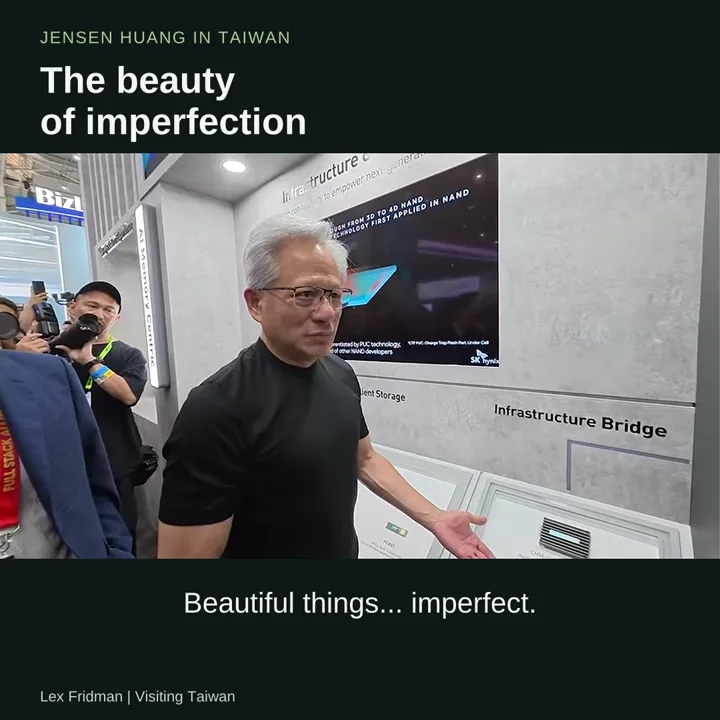
Original source · 31:01The beauty of imperfection
Look at that. That's beautiful. When I was young, I would think that that's not good. But now, I love wabi-sabi. Beautiful things... imperfect. I love that. Imperfection is beauty. Look at that. One of a kind.
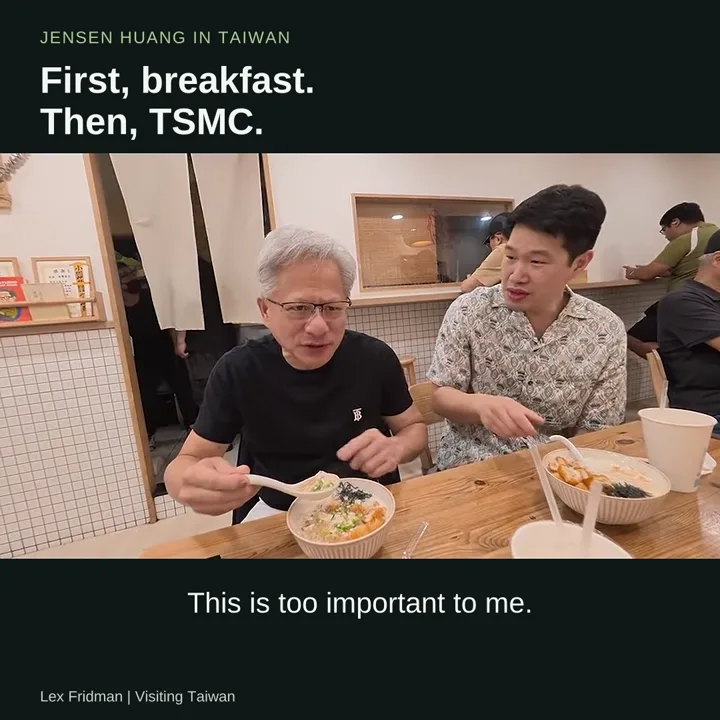
Original source · 7:34First, breakfast. Then, TSMC.
You said you were looking for a foundry. Just telling the story of how you first returned back to Taiwan... I see, I see. ...and built the relation with TSMC. You know, Windows 95. This is too important to me. TSMC or that? No, I can't talk. Okay, yeah. Priorities in life. Lex, I will share this with you in a second, but this is too important to me. There we go.
Original source · 1:11:47