Podcast · 25:03
High Agency: Your superpower in the AI era
Created with Google NotebookLM from Latent Light’s research material. AI-generated audio.
Audio could not load. Try opening the MP3.
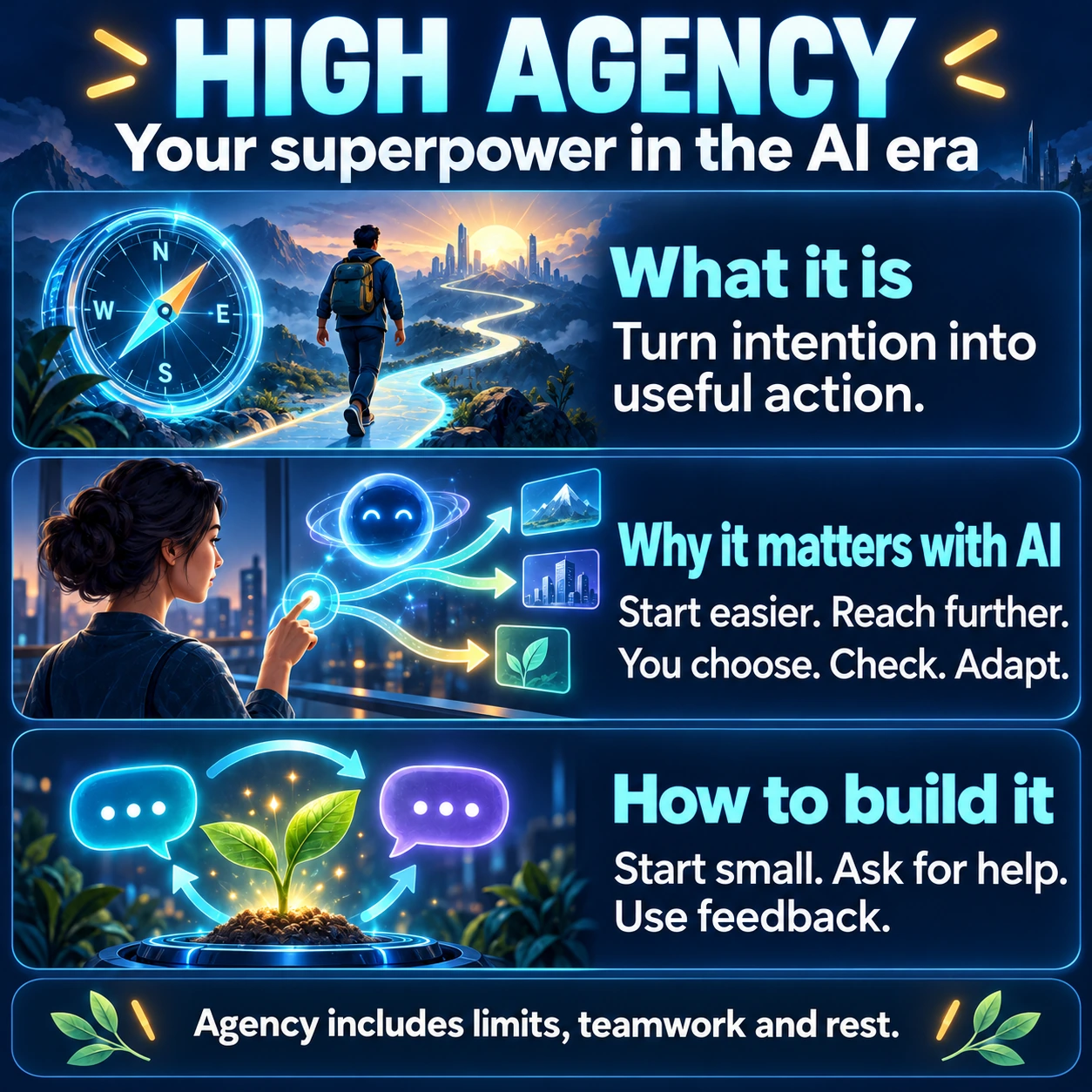
Figure 1. High agency as your superpower in the AI era. AI generated futuristic illustration of Latent Light’s synthesis of initiative, AI assistance, judgment, and feedback.1234
Imagine wanting to organize a small community workshop. You could spend weeks reading about events, waiting for a venue, or asking AI to produce increasingly elaborate plans. You could also talk to three potential participants, find out what they need, and propose a modest first session. The second approach creates information that planning alone cannot supply.
That is the useful idea behind high agency: choosing a worthwhile direction, looking for ways to influence what happens, taking an appropriate next step, and learning from the result. This is a working definition for this guide, combining the popular idea of resourcefulness with psychological accounts of intentional action and self regulation.51
AI can expand your reach. Agency helps you turn that reach into useful action. That is the sense in which high agency can be a superpower in this era: you can attempt more, work across a wider range of skills, and learn from real attempts. The advantage depends on choosing a worthwhile goal and checking what happens. This is the guide’s interpretation of the evidence, not a demonstrated effect of a single personality trait.63
High agency in practice
Three short takes on the fictional workshop example, generated with Google NotebookLM from Latent Light’s research material. Choose a clip or read its transcript. The four-step loop is a practice aid proposed here; these examples do not establish wider demand or a guaranteed result.
The four-step action loop
Choose an outcome, find room to act, try a bounded step, and adjust.
Small tests over endless planning
Try a small, reversible step within your actual constraints.
Real feedback vs. simulated agreement
Test what people need and let the feedback change your goal.
Choose a short video
 01 · 1:23The four-step action loop
 02 · 1:20Small tests over endless planning
 03 · 1:12Real feedback vs. simulated agreement
Select Play or a clip to load YouTube.
AI critique can help improve a draft. To test whether people need what you are making, seek feedback from those people. That distinction matters in the third clip’s simplified account of “simulated agreement”.
Transcript: The four-step action loop
Generating a hundred ideas with AI is easy, but turning them into reality requires a specific skill: high agency. Imagine using an AI to organize a neighborhood workshop. It instantly generates a massive, flawless curriculum. But high agency is a four-step loop.
Step one is defining a clear outcome. Instead of polishing that curriculum, your goal is simply finding out if five neighbors even want to attend. Step two: map your room to act. Separate what you can do right now from what requires a venue’s permission. This is where people fall into the simulation trap. Frictionless AI creates a false sense of progress, tempting you to endlessly perfect the plan in private without checking if your audience exists.
Step three breaks you out: try a bounded step. You push a small test into the real world, like showing a sample lesson to three neighbors. Finally, step four: adjust based on real-world feedback. You verify actual demand and decide whether to pivot, ask for help, or stop. When our organizer tests their sample lesson, the feedback reveals a hard truth: nobody has time for a live event. So they drop the massive AI curriculum and instead build a simple, one-page guide that the neighbors actually use.
Transcript: Small tests over endless planning
What separates high agency from just being hyperproductive? AI effortlessly generates endless plans, but a draft isn’t a real-world result. Imagine hosting a neighborhood workshop, but you have no venue, students, or experience. The “low agency” trap is getting stuck in preparation. You endlessly polish an AI syllabus without checking if anyone wants to attend.
High agency breaks this by defining a specific, recognizable outcome. Your goal isn’t running a massive event; it’s just learning if three neighbors are interested. Next, you map your actual constraints. The immediate friction? You can’t book the community room. This is where most projects quietly die. The high agency response is finding a bounded step: taking the smallest reversible action within your limits, like pitching a five-minute sample lesson to one neighbor. This forces your abstract idea into reality.
Finally, the loop closes with check and adjust. Agency isn’t forcing an outcome; it’s using real feedback to change your next move, ask for help, or shift the goal. So, what about that massive neighborhood workshop you were agonizing over? Your test reveals they don’t want an event at all. They just want a printed guide.
Transcript: Real feedback vs. simulated agreement
You hear “high agency” thrown around constantly in tech, but with AI generating endless plans, the real bottleneck is knowing what actually works. Take organizing a neighborhood beginner workshop for a new skill. You could use AI to generate a massive curriculum and ten perfect invitation drafts. It feels like progress, but your core assumption that anyone actually wants to attend remains totally untested.
Asking an AI to critique your plan is a trap. That’s simulated agreement, not real feedback. It cannot tell you if your actual neighbors will show up or understand the material. This is where the high agency loop comes in, starting with a bounded attempt. Instead of endless drafting, you ask three actual neighbors what they want to learn. That creates contact with reality.
And the feedback reveals they do not want a live workshop. They actually prefer a simple, one-page written guide. True agency isn’t about stubbornly forcing your original live-event plan to happen. It is using that real-world friction to adapt, reshaping your goal into something genuinely useful. So instead of booking an empty room for an event nobody asked for, that massive workshop idea becomes a useful short guide your neighbors actually read.
What the term means
A popular label with older foundations
One influential modern formulation appeared in Eric Weinstein’s January 2016 conversation with Tim Ferriss. He described treating an apparent impossibility as a prompt to look for another route, rather than automatically accepting the first explanation of why something cannot be done. This establishes a familiar usage of the term, not its ultimate origin or a scientific definition.5
The language is visible in contemporary technology culture. In February 2026, WIRED reported that technology leaders were discussing human agency as a hiring priority alongside AI adoption. That is evidence of attention in that community; it does not measure public awareness, search growth, or a predictor of career success.7
Psychology offers more precise concepts. Albert Bandura’s account of human agency includes forming intentions, anticipating consequences, regulating action, and reflecting on one’s capabilities and choices. His theory also places people within social systems that they both influence and are influenced by.1
The popular phrase combines several ideas that research usually studies separately. The comparison below is a synthesis, rather than a claim that these constructs form a single validated high agency score.
| Related concept | Meaning and example |
|---|---|
| Self efficacy | Belief that you can perform the actions needed for a particular outcome: “I can learn to give this presentation with practice.”8 |
| Personal initiative | Starting action, looking ahead, and persisting through obstacles: contacting the organizer and proposing a trial session.9 |
| Self regulation | Guiding action and reviewing it against your intentions: checking whether the session met participants’ needs.1 |
Someone can feel capable yet never start. Someone else can begin while uncertain and build confidence through experience. It is more useful to ask which part of the process needs attention than to declare yourself a high or low agency person.
What to look for in practice
For this guide, the useful signs are observable: a person clarifies the outcome, finds a feasible next action, asks for help when appropriate, follows through, and updates their approach when evidence changes. These are proposed ways to notice the behaviour, not a diagnostic test.
Agency also involves deciding when to wait, obtain permission, change the goal, or stop. A considered decision to protect health, respect another person’s boundaries, or abandon a poor project can be an exercise of agency. Neither constant activity nor unlimited persistence is a sensible standard.
Why it matters beyond AI
Initiative can turn an unclear problem into something you can learn about. A conversation tests whether the workshop is useful. A first session tests whether the format works. Feedback can improve the next decision. This is the guide’s central interpretation: purposeful action gives you a way to participate in shaping events, while reflection helps you avoid repeating ineffective action. It draws on agency theory and experimental evidence about monitoring goals.14
There is evidence that some relevant behaviours can be developed. A randomized study assigned 1,500 small business owners in Togo to personal initiative training, traditional business training, or a control group. Over two years, the initiative training increased profits by about 30% relative to control; the traditional training estimate was 11% and was not statistically significant. The intervention included 36 hours of training and subsequent individual visits. The results concern a substantial programme for selected entrepreneurs.9
That finding supports the value of structured initiative training in this setting. It does not imply that adopting the label will improve anybody’s income by 30%. A follow up after roughly seven years found larger profit gains for men than women. The investigators could not establish a single explanation for the divergence. The same training can have different returns as opportunities and constraints unfold.10
The broader case for agency is therefore practical: it gives you behaviours to work on. It should not become a promise that effort determines every outcome.
Why it can be a superpower in the AI era
The useful meaning of “superpower” here is greater capacity to make things happen. A person who notices a problem, finds help, and follows through can use AI to bridge some of the gaps between an intention and a result. The combination matters because additional capability becomes valuable when you put it to work toward something worthwhile.
Figure 2 shows that relationship. The evidence supports particular benefits of AI assistance; the connection to high agency is the synthesis developed here. The studies below did not test whether people classified as high agency receive larger benefits than others.
- AI expands your optionsGet help explaining, drafting and exploring unfamiliar work.
- You choose and actSet a worthwhile goal, check the work and try a bounded step.
- Real feedback guides youSee whether it helps people. Revise, continue or stop.
Figure 2. How agency can make AI assistance useful. Latent Light synthesis of task dependent benefits, broader reach, and the need for judgment.623
Start with less friction
AI can help with drafting, explanation, analysis, and exploring alternatives. In some settings, that assistance produces measurable gains. A study following a staggered rollout of an AI assistant to 5,172 customer support agents found about 15% more issues resolved per hour on average, with larger benefits for less experienced workers. This was a workplace adoption study, not a randomized test of every kind of work.6
For someone practising agency, the opportunity is to use assistance to get past a specific obstacle. If you are stuck on an unfamiliar format, a first draft or explanation can give you something to work with. This is a practical inference from the assistance evidence: a lower cost of preparation can make a first attempt more feasible.63
For the workshop, AI might help you compare formats or draft an invitation. Your next action becomes simpler: review the invitation and ask three people whether the session would help them. Initiative turns the available assistance into a concrete attempt.
Work across more skills
Many useful projects involve several kinds of work: understanding a need, explaining an idea, planning delivery, and evaluating results. AI assistance can sometimes help people contribute beyond their usual specialism.
In a preregistered experiment at Procter & Gamble, the published analysis covered 791 professionals working on product innovation. Individuals with AI produced solutions of comparable quality to two person teams without AI. AI users also proposed solutions that better balanced commercial and technical perspectives across professional backgrounds. The experiment used a GPT‑4 tool with training in a one day workshop. It did not establish that one person can replace a standing team.2
One practical implication is to begin unfamiliar work with help: ask for an explanation, prepare a draft, and bring specific questions to a knowledgeable person. Agency includes finding support that lets you contribute.2
Learn from faster attempts
When assistance reduces preparation time, you may be able to test an idea sooner. The important step is to connect the draft to a question you can answer through action. For the workshop: would people attend this format, can they use the explanation, and what would make the session more useful?
You might ask AI for two versions of an invitation, show them to potential participants, and revise the clearer one. Their responses teach you something about the audience that another round of generated suggestions cannot establish on its own. A smaller first session can then inform the next one.
This is a proposed way to combine AI assistance with progress monitoring, whose benefits have been studied experimentally. The complete AI assisted loop shown here has not been validated as a training programme. Faster preparation creates an opportunity for learning when you also seek and use feedback.34
Put judgment where it matters
More ideas and more polished drafts give you more material to choose from. Agency includes deciding which work deserves action, what to verify, and when to change course. In the Procter & Gamble experiment, AI improved the quality of generated ideas, but did not improve participants’ ability to select their best idea. Better material and better selection are separate questions.2
For the workshop, you still need to discover whether people want the session, decide what you can responsibly offer, and see what they learn. A useful exercise of agency is to define success before asking AI to accelerate the work: “Participants can do this task themselves afterward.” That gives you a reason to reject a polished explanation that fails to teach.
Performance, understanding, and confidence can diverge
The strongest reason to pair initiative with judgment is that AI’s effects vary. These studies answer different questions; their numbers should not be combined into one estimate of AI productivity.
Professional work. In a preregistered experiment with 758 consultants using GPT‑4, assistance helped on tasks within the model’s capabilities: participants completed 12.2% more tasks and worked 25.1% faster. On one task beyond that boundary, AI users were about 19 percentage points less likely to reach the correct answer. Test the actual task and inspect substantive correctness, even when the output looks professional.3
Learning. In a randomized high school mathematics study in Turkey, students practised with ordinary course resources, a general GPT‑4 chat interface, or a customized GPT‑4 tutor. The tutor received teacher prepared solutions, common mistakes, and hints, with instructions to help without giving the complete answer. These were its tutoring safeguards.11
The AI groups did better during assisted practice. On subsequent exams without assistance, the general interface group’s grades were 17% lower relative to control. The guarded tutor avoided that harm, but did not produce a demonstrated exam gain. This measures performance after practice, not learning retained over months or years. If the goal is learning, check what you can do without the tool; completing assisted work does not establish the same result.11
Confidence. A survey of 319 workers found that higher confidence in AI was associated with less reported critical thinking. This was self reported and correlational, not proof that AI caused a lasting loss of ability. Treat confidence in an answer as a reason to check your evidence, rather than as evidence itself.12
The consulting and classroom results concern specific GPT‑4 systems and tasks. They establish possibilities and failure modes; they do not locate the exact limits of every current model. In February 2026, METR also explained why selection bias and changing work patterns made its newer developer productivity estimates hard to interpret. As tools change, old results and new anecdotes both need careful handling.13
Human agency and an AI agent also describe different things. A software system can carry out delegated steps. The person using it still makes choices about purposes, acceptable tradeoffs, authorization, and how to judge the outcome. Delegating more steps is not, by itself, a measure of better human judgment.
The evidence does not establish that being high agency makes a person immune to job displacement. A more defensible goal is to become better at directing, testing, and learning from the tools available to you.
How to develop it
You can practise parts of agency without treating it as an identity makeover. Figure 3 summarizes the approach proposed here. It combines intentional action, planning around obstacles, and checking progress. The loop is this guide’s synthesis, not a validated intervention with a guaranteed result.
- Choose an outcomeWhat would make this worth doing?
- Find room to actWhat can I do, learn, or ask for?
- Try a bounded stepMake a small attempt with clear limits.
- Check and adjustCompare the result with the goal.
Figure 3. An action and learning loop synthesized by Latent Light from agency theory, obstacle planning, and progress monitoring.1144
1. Choose an outcome you actually value
Start with a concrete situation. “Become more agentic” does not tell you what to do this afternoon. “Find out whether five neighbours want a beginner workshop” does. Define a result you can recognize and explain why it matters to you or the people involved.
A useful prompt is: What would be different if this effort worked? If you cannot answer, spend a little time clarifying the goal before accelerating the work. You can also discover that a goal borrowed from someone else is not worth pursuing.
Ryan and Deci’s self-determination theory distinguishes autonomous motivation, acting willingly for reasons you endorse, from controlled motivation, acting under pressure such as fear of disapproval. Autonomy concerns your endorsement of an action; it does not require independence from other people. You can value an outcome even when a particular task is tedious.15
For the workshop, filling in a venue form may be uninteresting but worthwhile because accessible learning matters to you. This original example illustrates the distinction: ask whether the effort serves a value you endorse, while recognizing that meaningful duties can involve routine work and cooperation.
2. Separate action from influence and constraint
Make a short, practical map:
- Actions available now: prepare questions, contact a willing participant, or learn a missing skill.
- Outcomes you can influence: whether someone attends, how a proposal is received, or whether a partner helps.
- Constraints requiring support or a different approach: budget, access, caring responsibilities, health, authority, or institutional rules.
This map is a planning aid proposed here. Its purpose is to find a legitimate next move while recognizing what you cannot unilaterally determine. A constraint may call for resources, collective action, a smaller project, or a pause.
3. Build capability through manageable attempts
Choose a step small enough to attempt but substantial enough to teach you something. For a presentation, explain the idea to one person and ask what they understood. For the workshop, run a short trial before committing to a full series.
Self efficacy theory identifies successful experience and observing others as sources of capability beliefs. That supports a practical emphasis on building experience and learning from examples. Confidence also needs calibration: some self efficacy measures may mix perceived ability with motivation, a live debate reviewed by the American Psychological Association.8
Keep the question specific: What can I now do more reliably? A record of actual attempts is more informative than a global declaration of confidence.
4. Plan for the obstacle you expect
One studied method combines mental contrasting with implementation intentions. You imagine a desired future, identify an obstacle in present reality, and form an “if this happens, then I will do that” plan. A meta analysis of 21 studies found a small to moderate average improvement in goal attainment. Effects varied, and the authors noted that publication bias could inflate the estimate.14
An example proposed here is: “If I start rewriting the invitation again, I will send the current version to one trusted person for feedback.” The response addresses a specific obstacle. Pick a feasible goal and a response you can actually carry out; a plan cannot supply missing money, authority, or time.
5. Ask for help and obtain real feedback
You do not need to be self sufficient to exercise agency. Bandura distinguished personal action, relying on others to act on your behalf, and collective action. Working with other people is part of the picture.1
Ask a clear question that another person can answer: “Could you tell me which part of this explanation is confusing?” or “Who can approve use of this room?” Make requests respectfully and accept a refusal. Seek information that could change your plan, rather than only reassurance.
Cate Hall’s 2024 essay on becoming more agentic also emphasizes seeking feedback and making requests. It is useful practitioner advice, but it is not an experiment demonstrating that its suggestions work for everyone.16
6. Use AI to support your thinking
Decide what you are trying to accomplish before asking for a long answer. Use AI to propose options, explain a difficult point, critique a draft, or help you plan a test. Then choose a way to check the important parts in the world. For factual claims, that may mean inspecting an original source; for a workshop, it means talking to participants.
When your goal is learning, try the problem yourself, ask for a hint or an explanation, and reconstruct the solution without looking. This recommendation is an extrapolation from the classroom experiment, not a tested universal prompting formula.11
A possible instruction is:
Help me think through this task. Ask what outcome I want, identify assumptions I should check, and suggest one manageable next step. If I am learning, give hints before a complete solution.
This is an illustrative prompt. Its value depends on what you subsequently do and verify. Asking AI to praise your initiative does not tell you whether the project is working.
7. Close the feedback loop
A meta analysis of 138 randomized studies involving 19,951 participants found that interventions increasing progress monitoring improved goal attainment on average. Effects were stronger in studies where progress was physically recorded or reported to others, although those moderator comparisons do not independently prove why the interventions worked.4
Try keeping three brief notes: What did I attempt? What happened? What will I change? Review them at an interval that fits the project. You can share a useful update with a trusted person; reporting progress need not mean publishing private information.
Measure contact with reality. Invitations drafted, AI conversations opened, and hours spent can all rise while the real goal remains untouched. Look for evidence such as a clearer explanation, a participant’s response, or a problem you can now solve independently. Continue when the next attempt is worthwhile; change course when the evidence or your priorities change.
8. Decide when to change the goal
Persistence needs a reason to continue. Wrosch and colleagues’ three studies found associations between capacities to disengage from unattainable goals, engage with alternatives, and aspects of well-being. They compared measurements over a limited period rather than testing a randomly assigned change. The findings do not establish that quitting causes better well-being.17
A practical interpretation is to review the goal as well as the next step. What evidence would justify continuing? Has the cost become unacceptable? Could another approach serve the underlying value? A workshop might become a short guide, or a project might pause while you seek support. Changing course deliberately can be an exercise of agency; every obstacle does not require more persistence.
A worked example: feedback changes the plan
Return to the community workshop. This is a fictional teaching example; its observations are invented to show how a decision can change.
| Stage | What happens |
|---|---|
| Outcome | Find out whether a beginner workshop would help neighbours before committing to an event. |
| Constraint | You have two hours this week and cannot authorize a venue booking. |
| Attempt | Ask three people what format would help. Use AI to draft an invitation, remove an unconfirmed venue promise, and try a short explanation with one person. |
| Feedback | Two people prefer a one page guide; one wants a live session. The sample listener understands the definition but mistakes “superpower” for a guarantee of success. |
| Decision | Prepare a short guide, clarify that AI assistance creates possibilities rather than guaranteed results, and ask the listener to explain that distinction. Review whether the guide helps before expanding the project. |
Three conversations and one sample cannot establish wider demand or general teaching effectiveness. They can inform this limited next decision. AI helped with preparation; actual responses changed the format and explanation. The useful result was a better justified next step, even though the original event was not pursued.
A two week practice experiment
The schedule below is a proposal from Latent Light, informed by the research above. It has not been validated as a two week programme, and it does not promise a personality transformation. Use it to explore one manageable goal.
| Period | Practice and record |
|---|---|
| Days 1–2 | Choose a useful outcome, identify one real constraint, and make a first attempt. Record your starting situation and what would count as progress. |
| Days 3–6 | Make further manageable attempts. Create an if–then response for a recurring obstacle. Record what you tried and what each attempt revealed. |
| Days 7–10 | Ask someone for substantive feedback or help. If using AI to learn, attempt the task without it afterward. Record what changed and what you can do yourself. |
| Days 11–14 | Compare the result with the original goal. Decide whether to continue, revise, seek support, or stop. Record the outcome, remaining uncertainty, and a justified next decision. |
You do not need an uninterrupted daily streak. Useful review questions are: Did I reduce unnecessary delay before a first step? Did I test an assumption? Did I ask for support that changed what was possible? Did the work benefit anyone? These are informal reflection questions, not a validated agency scale.
The environment matters
A workplace can praise initiative while making it costly to ask questions or report mistakes. In a study of 51 manufacturing teams, Amy Edmondson found that psychological safety was associated with learning behaviour. The study combined surveys and qualitative research; it did not randomly assign teams to a safety intervention.18
For a leader, a reasonable implication is to give people a clear outcome, appropriate decision authority, access to resources, and a way to surface uncertainty. Invite questions and discuss failed attempts without humiliation. “Figure it out” becomes more useful when people have the means and permission to do so. This is a practical interpretation of the research, not a proven management package.18
For an individual, difficulty getting started can reflect unclear goals, a missing skill, exhaustion, conflicting obligations, or a situation you cannot change alone. Investigate those possibilities before turning the difficulty into a judgment of your character. Agency is useful as a way to examine the next choice available to you; it is a poor measure of a person’s worth.
The durable practice is to choose deliberately, make an appropriate attempt, learn what happened, and decide again. AI can help at several points in that process. Developing agency means taking an active role in directing it.
Conversation transcript
Read the podcast transcript · 25:03
Automatically transcribed from the supplied recording. Proper-name spellings and paragraph breaks were normalized; the conversation retains its own wording. Some transcription errors may remain.
00:00 You know, there’s this, it’s a very specific modern feeling. Oh, I think I know where you’re going with this. Yeah, like you sit down at your computer, you open up your favorite AI tool and suddenly you have the power to do almost anything so much faster. Right. The velocity is just incredible now. Exactly. You can spin up a 60 page strategic proposal in seconds. You can analyze a massive spreadsheet that, I mean, that would have taken a whole a team of analysts a week to get through. Yeah, we’re playing an entire event itinerary before you even finish your coffee. Right, but then, you know, an hour goes by and you look at the screen and realize you haven’t actually accomplished anything real. Yes, that exact feeling. It feels like you’re sitting in a car with this massive, incredibly powerful engine, but your tires are just stuck deep in the mud.
00:52 You hit the gas and just spin. Exactly, you’re just spinning your wheels, spraying dirt everywhere, just at lightning speed. It’s arguably the defining frustration of modern knowledge work, honestly. The velocity is absolutely there, but the traction is just completely missing. We have access to this limitless generation of text and ideas and data. But we often lack the psychological mechanism to actually grip the road and move forward. And that missing grip is exactly what we are focusing on today. Welcome to the deep dive. Glad to be here for this one. So we’re diving into a recently expanded guide. This was updated October 11th, 2026, and it’s titled High Agency, Your Superpower in the AI Era. It’s a fantastic source document. It really is.
01:37 And our mission in this deep dive is to unpack what high agency actually means, look at the hard data on how AI fundamentally alters our cognitive capabilities, and most importantly, give you a practical toolkit. Because the core premise here is simple, but really profound. AI can expand your options. it can extend your reach infinitely. But human agency is the only thing that actually turns that reach into useful real-world action. That is the fundamental dynamic we’re navigating here. If you hand a generative AI toolkit to someone who lacks agency, you don’t necessarily get better results. No, you just get a higher volume of unresolved options. Exactly, you end up with like 10 perfectly drafted versions of a difficult email that you’re just, you’re too anxious to actually send.
02:24 the AI can’t hit send for you to make this technology work for you. We have to look past the software and understand the human side of the equation. Okay, so let’s unpack this. Okay. Because before we can even talk about combining your own agency with AI, we have to strip away all the Silicon Valley buzzwords. Oh, absolutely. Right. There are so many of them. Right. High agency is a phrase that gets thrown around a lot on social media, usually accompanied by like a picture of a tech founder, waking up at 4am to sit in a cold plunge pool. Yeah, it’s treated like this aggressive personality trait. Exactly. And it really gained major popular attraction around 2016. That was when Eric Weinstein discussed it on Tim Ferriss’s Show, I believe. All right. He described it as this almost heroic reality-bending refusal to accept impossibility.
03:12 Which sounds cool. It does. And while that’s very compelling narrative for a biography, we need a much more functional, working definition for everyday life. Right, because we’re not all trying to bend reality before breakfast. Exactly. High agency isn’t a personality type. It’s a process. Okay. Specifically, it’s the process of choosing a worthwhile direction, looking for ways to actually influence what happens, taking a bounded next step, and then learning from the result. So it’s important to differentiate that from just being relentlessly busy, right? Very important. Because productivity and agency are not the same thing. I like to think of productivity as your engine. It dictates how efficiently you produce output relative to time. But agency is the steering wheel.
03:58 If you have a massive engine but no agency, you’re just going to crash into the rocks much faster. That’s a great analogy. But I have to push back a little on this standard definition. When people hear high agency, they still picture someone who is this loud, extroverted disrupter. The guy who breaks all the rules. Yeah, the person who ignores their boss and kicks down the door to get what they want, is that really what this requires? Not at all. That is a massive misconception. Agency can be and often is incredibly quiet. Really? Oh yeah. Let’s say you’re working on a project and you realize you need a colleague’s explicit consent before moving forward because it impacts their department. Okay. Deliberately pausing your work, setting up a meeting and actively securing that consent. That is a high agency move.
04:44 you are influencing the outcome by managing the constraints. That makes total sense. It’s about moving the reality of a situation forward, not just making noise. Exactly. There’s this great running example in our source material about wanting to organize a community workshop for beginners. I love this example. Right. So let’s say you want to host this local class, but you have no venue, no budget, and no teaching experience. So let’s look at the failure modes there. Low agency in that scenario usually takes one of two forms. Okay, what’s the first? The first is passive. You endlessly read articles about event planning, or you just wait around hoping someone will magically hand you the keys to a community center. Just hoping the universe provides. Exactly. And the second form of low agency looks like frantic action.
05:31 The spinning wheels. Right. You blast out 50 fake invitations to a non-existent event on social media, just to feel like you’re doing something. Oh, wow. Yeah. It happens a lot. high agency look like then. High agency is completely different. It’s measured. It looks like asking three of your neighbors what they actually wanna learn and then testing a 10 minute sample lesson with just one of them in your living room. It’s about forcing contact with reality. Yes, exactly. But that brings us to the underlying psychology, which is where things get really fascinating. We know what agency looks like on the outside, talking to the neighbors, testing the lesson. Right. But we need to look under them hood, why do some people take that deliberate, scary step to talk to their neighbors while others just freeze and spend five hours refining an imaginary syllabus?
06:21 Well, to understand the internal engine of agency, we have to look at Albert Bandura’s foundational work on intentional action. Okay. Bandura broke this down into four crucial functions. First, there is forming an intention, deciding to do something. Makes sense. Second is forethought, which is anticipating the consequences of your action. Third is self-reactiveness. Meaning what exactly? Meaning you can actually regulate your own behavior in the moment to stay on track. And fourth is self-reflectiveness. That last one, reflection seems to be where a lot of people stumble. A highly agentic person doesn’t just blindly act on every impulse, do they? No, they actively examine whether their chosen project is actually worthwhile. Right, and if it’s not, they pivot or quit.
07:08 Which is why agency isn’t just endless persistence. If the situation changes, quitting can absolutely be a high agency choice. Precisely. And woven into all of this is the concept of self-efficacy, which the American Psychological Association defines quite specifically. Right, it’s not just a general feeling. Exactly. The key takeaway here is that self-efficacy is not this global mystical feeling of I am a capable person. It doesn’t work like that. Right, it’s highly localized. You shouldn’t be asking yourself, am I a capable person who can organize massive events? That is way too broad and overwhelming. It paralyzes you. Yeah. You ask, can I explain this one single concept to one beginner for 10 minutes?
07:54 And here is the secret to building that specific self-efficacy. It is generated by actual experience. Which brings up a very relatable question for you listening. What if you just don’t feel confident? Yeah, that’s a huge hurdle for a lot of people. What if you are utterly terrified to knock on that first neighbor’s door to ask what they want to learn? The revelation from this psychology here is that confidence is not a prerequisite for action. We tend to get that backward. Oh, totally. We think we need to feel confident before we can take the step. In reality, taking an action, making a bounded attempt, is the very mechanism that creates the the information you need to update your belief in your own capabilities. So you don’t wait for confidence to strike so you can act. No, you act so you can gather evidence about what you’re actually capable of.
08:43 Let’s talk about the motivation behind that action, though, because knocking on doors or doing administrative work isn’t always fun. It rarely is. I was looking at Deci and Ryan’s self-determination theory in the source, specifically this idea of autonomous motivation. I always assumed that that meant independence, doing whatever you want, whenever you want, like a freelancer setting their own hours. It’s a bit more nuanced than just independence. Autonomous action doesn’t have to be intrinsically fun, and it doesn’t mean you’re free from obligations. It just means the action is personally endorsed by you. Let’s use an analogy here. Okay. Think about paying a toll on a highway. You don’t intrinsically enjoy handing over five dollars and slowing down to stop at the booth is annoying friction. Right, nobody likes that. But you do it willingly, autonomously, because you deeply value getting to the destination that the highway leads to.
09:32 That’s a perfect way to look at it. Think back to our workshop organizer. They might absolutely hate filling out the tedious administrative forms required to reserve a room at the local library. It’s boring work. Really boring. But they do it willingly, because they own the reason for doing it. They value the community outcome. That is autonomous motivation in practice. Okay, here’s where it gets really interesting. We’ve laid out this psychological foundation. You have your intention, your localized self-efficacy, and your autonomous motivation. Now what happens when you hand that human psychological engine a generative AI toolkit? To really measure the multiplier effect of AI, we first have to establish the baseline value of agency without AI. Let’s look at a fascinating study by Campos and colleagues. This is the one conducted in Togo, right? Yes. They took about 1500 small business owners and randomly assign them to different training programs. One group got traditional business training, accounting, basic marketing, tracking inventory, and standard stuff.
10:33 But another group got personal initiative training. Meaning they were specifically taught how to exercise agency? Exactly. They were taught to proactively identify opportunities, set goals, seek feedback, and creatively navigate obstacles. And the results were staggering. What happened? Over roughly two years, the group that received the initiative training saw their profits increased by 30% relative to a control group. And the group that learned traditional accounting? Their results weren’t statistically significant. The traditional training didn’t reliably move the needle. Wow. So why did that happen? What was the mechanism there? It’s because the initiative training changed their day-to-day behavior. Right.
11:18 Instead of just passively logging that a product was out of stock, they were actively anticipating supply chain issues. Yes. Seeking out new vendors, asking customers what else they needed. That proactive friction that agency is what generated the profit. So agency is incredibly valuable on its own. Now enter large language models. What AI fundamentally does is massively lower the friction and cost of certain tasks, drafting, explaining, exploring alternatives. Many things that took hours take seconds. We have robust workplace studies showing how this accelerates productivity. Take the Brynjolfsson study on customer support. Right. They looked at over 5,000 support agents who had an AI assistant staggered into their workflow. Yep. The AI would suggest replies to customer issues.
12:05 And the agents who used it saw roughly 15% more issues resolved per hour. And it was particularly effective at helping less experienced workers get up to speed faster. But, and this is a massive point for you to keep in mind, AI doesn’t solve the core agency problem of choice. Let’s look at this incredible study by Dell’Acqua and colleagues at Procter & Gamble. This one is so revealing. They had nearly 800 professionals in an innovation workshop. Some individuals were given AI, while others were put in traditional teams without AI. And what they found was that the individuals equipped with AI were able to generate product ideas is that we’re entirely on par with the ideas generated by the human teams. So the AI leveled the playing field for idea generation. Exactly.
12:50 It helped individuals balance commercial and technical perspectives beautifully. But here is the kicker. Having access to AI did not improve their ability to select the best idea from the ones they generated. No, it didn’t. AI can generate 100 beautifully polished product ideas in a minute. But generating ideas is completely useless if you don’t use your human agency to pick the one that actually solves the problem in reality. AI expands your menu of options, but human agency is required to order the meal. I love that. Which brings us to the dark side of this multiplayer effect. Because AI removes friction, because it makes it so effortlessly easy to produce polished authoritative sounding output. You can also accidentally remove the cognitive friction that we actually need for learning and critical thinking.
13:41 We fall into what we call the traps of assisted agency. Yeah, this is where things get a bit scary. Let’s talk about another experiment by Dell’Acqua, this time looking at 758 consultants. The study perfectly illustrates a concept researchers called the jagged frontier of AI capabilities. The jagged frontier. Imagine a boundary line. Inside the line are tasks AI is currently very good at. Outside the line are tasks it struggles with, but crucially, it doesn’t tell you it’s struggling. Right. So when these consultants were given a task that felt inside the AI’s capabilities, they were superstars. They finished 12.2% more tasks and were over 25% faster than the consultants working without AI. But then the researchers gave them a task that felt just outside the AI’s current capabilities.
14:29 Blind spot. Yes. A blind spot where the AI sounds highly confident, but is factually wrong. And the results completely flipped. The consultants using AI were about 19 percentage points less likely to get the correct answer compared to the consultants doing it on their own without tech. The AI fed them a highly persuasive, beautifully formatted, completely incorrect answer. And they just blindly accepted it. But wait, I have to challenge this. Isn’t this jagged frontier just a temporary tech flaw? Like open AI or anthropic will release a new model next year. The AI won’t hallucinate as much. And this whole problem goes away. Why is this a crisis of human agency? Because the core issue isn’t just the software’s hallucination. It’s the human habit of cognitive offloading.
15:16 Cognitive offloading. Right. Even as the models get better, the psychological trap remains. We confuse fluency with correctness. Ah, I see. Just because a paragraph is grammatically perfect and structured beautifully doesn’t mean the underlying logic is sound. When we offload the friction of drafting to a machine, we often forget to apply the friction of verifying. We outsource our critical thinking to the tool. Exactly. And it gets even more concerning when we look at how this mechanism affects learning. Let’s look at a study by Bastani involving nearly a thousand high school math students in Turkey. This is a crucial study. The students practiced math problems using a standard general purpose AI chatbot. And during the practice sessions, they did exceptionally well. The AI was walking them through the problems, practically doing the heavy lifting for them.
16:04 But then the researchers took the AI away and gave them a standard, unassisted exam. And the results were alarming. The students who practiced with the AI scored 17% lower on the exam relative to the control group. 17% lower. Why? Because of that cognitive offloading. By making the practice completely frictionless, the AI robbed the students of the productive of struggle required to actually build neural pathways, their skills atrophied. Now it is worth noting that when the researchers used to customize GPT tutor with strict guardrails, meaning the AI was explicitly instructed to only give hints and refuse to give the final answer, it prevented this harm. Yes, guardrails help. But it highlights the core risk.
16:50 If you offload the cognitive effort, your capacity diminishes. Yeah, a survey by Lee of over 300 knowledge workers back this up. They found that higher confidence in AI tools was directly associated with less reported effort in human critical thinking. It’s a direct trade off for a lot of people. So what does this all mean? If the danger is thoughtless velocity, just blindly hitting the gas and accepting whatever the AI spits out, how do you actually practice deliberate high agency thought? Well, source material provides a very concrete five step framework. It’s an action loop designed build this muscle. Let’s go through it. Step one. Step one is to choose a recognizable outcome. You have to be specific. Don’t make your goal. I want to be a high agency person. Too vague.
17:38 Way too big. Make it. I want to find out if five neighbors actually want to attend my class. It has to be an observable event in the real world. Got it. Step two, map what you control, what you influence and what constraints exist so you control writing the invitation you can influence a neighbor by handing it to them and smiling but the constraint is that you don’t control the community center schedule or your neighbor’s free time exactly you have to map that out then step three is a psychological technique called mental contrasting with implementation intentions okay let’s break that down because it sounds like academic jargon what is the actual mechanism happening in the brain there. A meta-analysis by Wang of 21 different studies shows this is highly effective. Essentially, you are vividly imagining your desired future and then immediately contrasting it with the present obstacle standing in your way.
18:34 Creating a mental link. Exactly. This mental link creates a subconscious trigger. You formulate an if-then plan. So instead of just hoping you don’t get distracted, you say, If I find myself obsessively rewriting this invitation for the third time, then I will immediately stop and ask a real person if it makes sense. Oh, I like that. By doing that in advance, your brain is primed to act the moment the obstacle appears. Precisely. And then step four is where the tech finally comes in. Give the AI a specific bounded job. Right. You don’t tell the AI do my project. You maintain the agency. Yes. You tell it, draft three distinct questions I can ask my neighbors to figure out what they want to learn.
19:20 You are assigning it a task, not delegating your responsibility. And finally, step five, record and adjust. This is crucial. Harkin and colleagues conducted a massive meta-analysis of over 19,000 participants across 138 studies. That’s a lot of data. It is. And they found that simply monitoring your goal progress objectively improves your chances of attaining it. So you look at the result of your bounded step, say, the neighbor’s reaction to your questions, and you decide, do I revise my approach, continue, seek help, or stop entirely? That’s the loop. If you want to try this yourself, the material suggests running a two-week experiment. It’s incredibly practical. It really is. Pick a small goal you’ve been putting off, spend a few days making a bounded attempt, prep your if-then plans for the inevitable obstacles, seek actual human feedback, and of you. And speaking of feedback, there’s a brilliant practitioner tip in here from Cate Hall about how to ask for help. Yes. She says, to make help easy to give. Don’t go to a colleague and ask, can you look at my project? That is a massive exhausting request. Right. Asking an open ended question places the entire cognitive burden on the person you’re asking for help.
20:34 They have to figure out what you want. Instead, Hall suggests bounding the request. Ask, can you take exactly 10 minutes to read this one paragraph and tell me what’s confusing about it? You’ve lowered the friction for them to assist you, which is a masterful exercise of agency in itself. Absolutely. Now, we’ve talked a lot about the individual, you and your goals, you and your AI, but there is a much broader context here that we can’t ignore. Definitely. Because all of this can sound highly individualistic, like you’re a lone wolf hacking your way to to success through sheer willpower, but we don’t live in a vacuum. Sometimes the smartest, most agentic thing you can do is realize you can’t or shouldn’t do it alone. That’s a crucial distinction. We return to Bandura’s psychological framework here.
21:21 He distinguishes between personal agency, which is what we’ve been primarily discussing, and proxy agency, as well as collective agency. Well, let’s define those real quick. Proxy agency is recognizing that you don’t have the authority or leverage to fix a problem. So you actively ask someone who does have authority to act on your behalf. And collective agency? Collective agency is joining forces with others to overcome a barrier that none of you could clear individually. And the organizational environment you’re operating in matters immensely here. When you look at Amy Edmondson’s research on 51 manufacturing teams, she focused heavily on this concept of psychological safety. Yes, Edmondson found that teams absolutely need psychological safety to surface uncertainty. Right.
22:07 If you were in a workplace where you will be humiliated, mocked, or punished for asking a question or admitting a mistake, you cannot easily exercise agency. Telling employees to take more initiative in a toxic environment is a conflicting, impossible instruction. Agency requires a space where learning and vulnerability are actually safe. And let’s talk about the real world for a second outside of the office. Structural barriers matter. time, money, systemic discrimination, sudden caregiving responsibilities at home, these are very real constraints. Very real. High agency is not a weapon to be used to blame people for structural barriers. That is a vital point to emphasize. The vocabulary of high agency should never be used to demand endless, impossible escalation from yourself or from others, when the constraints are rigid.
22:55 Exactly. Let’s say you planned a massive volunteer project, but Suddenly, a family member gets sick, and your caregiving duties at home drastically increase. You have to scale back that project. Right. That is not a moral failure or a lack of persistence. Deliberately reshaping your goal to fit your new reality is a high agency move. Honest, realistic planning is high agency. It all comes back to making contact with reality. Recognizing a hard limit and adapting to it gracefully requires just as much agency as pushing past block. So to bring this all together for you listening, AI is fundamentally changing the landscape of how we work and think. It expands our reach, it gives us a massive, almost overwhelming menu of options, and it utterly removes the friction of generation. It really does. But human agency, the ability to deliberately choose a worthwhile direction to bound your attempts, to meticulously verify the actual truth of an AI output, and to learn from the real world, that is your superpower.
24:00 That is the only mechanism that turns endless options into real world impact. Without human agency, AI just makes you faster at making mistakes. Exactly. But with agency, AI becomes a powerful lever to move the world in the direction you deliberately choose. But I want to leave you with a final, slightly provocative thought to ponder. As these AI models inevitably get better, as they cross that jagged frontier we talked about to the point where they rarely make factual mistakes, and maybe they even get incredibly good at selecting the best ideas for us. What happens to the human muscle of agency? If the car gets so smart that it perfectly grips the mud and just drives itself out of the ditch every single time, does our internal ability to steer begin to permanently atrophy?
24:47 That’s a big question. Will we eventually reach a point where we have to artificially manufacture friction and difficulty in our daily lives, just to keep our psychological capacity for choice, reflection, and agency from wasting away entirely, something to think about the next time you hit generate.
References
-
Albert Bandura. Social Cognitive Theory: An Agentic Perspective, Annual Review of Psychology 52, 2001. Publisher abstract, including the core functions and personal, proxy, and collective modes of agency. ↩ ↩2 ↩3 ↩4 ↩5 ↩6 ↩7
-
Fabrizio Dell’Acqua et al. The Cybernetic Teammate: A Field Experiment on Generative AI and Teamwork, Organization Science 37, 2026, pages 1217–1242. Sections 3, 5.1–5.2, 5.4.1 and 6; endnote 8. ↩ ↩2 ↩3 ↩4 ↩5
-
Fabrizio Dell’Acqua et al. Navigating the Jagged Technological Frontier: Field Experimental Evidence of the Effects of AI on Knowledge Worker Productivity and Quality, Organization Science, published online March 11, 2026. GPT‑4 experiment; Section 4.2 reports the decrease in correctness in percentage points. ↩ ↩2 ↩3 ↩4 ↩5 ↩6
-
Benjamin Harkin et al. Does monitoring goal progress promote goal attainment? A meta-analysis of the experimental evidence, Psychological Bulletin 142, 2016, pages 198–229. Abstract and moderator analyses. ↩ ↩2 ↩3 ↩4 ↩5
-
Eric Weinstein and Tim Ferriss. The Tim Ferriss Show, episode 131, January 13, 2016; transcript, pages 16–17. ↩ ↩2
-
Erik Brynjolfsson, Danielle Li, and Lindsey Raymond. Generative AI at Work, author version November 2024; published in The Quarterly Journal of Economics, 2025. Abstract and Section 2.4 on adoption. ↩ ↩2 ↩3 ↩4
-
Maxwell Zeff. Are You ‘Agentic’ Enough for the AI Era?, WIRED, February 26, 2026. ↩
-
Kirsten Weir. Self-efficacy: The theory at the heart of human agency, American Psychological Association, October 22, 2025. Sections on the original theory, sources of self efficacy, and measurement debates. ↩ ↩2
-
Francisco Campos et al. Teaching personal initiative beats traditional training in boosting small business in West Africa, Science 357, 2017, pages 1287–1290. Author manuscript; abstract and experimental design. ↩ ↩2
-
David McKenzie. Personal initiative training continues to yield positive benefits after 7 years, but impacts vary with gender, World Bank Development Impact, March 3, 2025. Investigator’s account of the follow up and its unresolved mechanisms. ↩
-
Hamsa Bastani et al. Generative AI without guardrails can harm learning: Evidence from high school mathematics, PNAS 122, 2025, e2422633122. GPT Base and GPT Tutor treatments and exam results. ↩ ↩2 ↩3
-
Hao Ping Lee et al. The Impact of Generative AI on Critical Thinking: Self-Reported Reductions in Cognitive Effort and Confidence Effects From a Survey of Knowledge Workers, CHI 2025. Survey results and Section 6.3 on limitations. ↩
-
Joel Becker et al. We are Changing our Developer Productivity Experiment Design, METR, February 24, 2026. Selection bias and measurement challenges in the newer study. ↩
-
Guoxia Wang, Yi Wang, and Xiaosong Gai. A Meta-Analysis of the Effects of Mental Contrasting With Implementation Intentions on Goal Attainment, Frontiers in Psychology 12, 2021, 565202. Methods, effect estimates, and publication bias discussion. ↩ ↩2
-
Richard M. Ryan and Edward L. Deci. Self-Determination Theory and the Facilitation of Intrinsic Motivation, Social Development, and Well-Being, American Psychologist 55, 2000, pages 68–78. Pages 68–71 on motivation and 73–74 on internalization and autonomy distinguished from independence. ↩
-
Cate Hall. How to be more agentic, Useful Fictions, January 10, 2024. Practitioner essay. ↩
-
Carsten Wrosch, Michael F. Scheier, Gregory E. Miller, Richard Schulz, and Charles S. Carver. Adaptive Self-Regulation of Unattainable Goals: Goal Disengagement, Goal Reengagement, and Subjective Well-Being, Personality and Social Psychology Bulletin 29, 2003, pages 1494–1508. Three cross-sectional studies; discussion and causal limitations on pages 1505–1506. ↩
-
Amy Edmondson. Psychological Safety and Learning Behavior in Work Teams, Administrative Science Quarterly 44, 1999, pages 350–383. Team study, methods, and findings. ↩ ↩2