A trained model describes a computation. An application needs a program that can execute that computation on its target device, allocate memory, move inputs and return results. The route between these two is where runtimes and compilers matter. The same weights can perform differently when operator implementations, tensor layouts, shapes or processor assignments change.
Treat a deployment as a specific combination of model, runtime, backend, device, precision and versions. Support for an accelerator is not a promise that every model will run entirely on it. ExecuTorch documents partial delegation and CPU fallback; ONNX Runtime assigns supported graph regions to execution providers.12
This page explains that execution route and compares useful software boundaries. For chip roles, memory arrangements and current devices, read On device computing. For workload budgets, read Edge AI foundations. For weight representation, continue with quantization and compression.
Separate the program from its execution
An operator is a computation such as matrix multiplication. A kernel is a particular implementation of it. A backend connects execution to a target processor or library. A runtime loads the program and manages its execution; a compiler or conversion tool can prepare that program before the app runs. ExecuTorch uses these distinctions in its concepts guide.3
The boundary is not always one compiler followed by one runtime. Some work is performed ahead of time; some optimization or device compilation occurs at session initialization. An optimized artifact can depend on the intended hardware and execution-provider settings.4
Figure 1 is ExecuTorch’s own view of this boundary. The dashed box contains ahead-of-time preparation: graph export, target compilation, memory planning and kernel selection. The runtime sits outside it and executes operators and delegates. This is one stack’s organization, not a universal pipeline or a claim that initialization has no work left to do.5
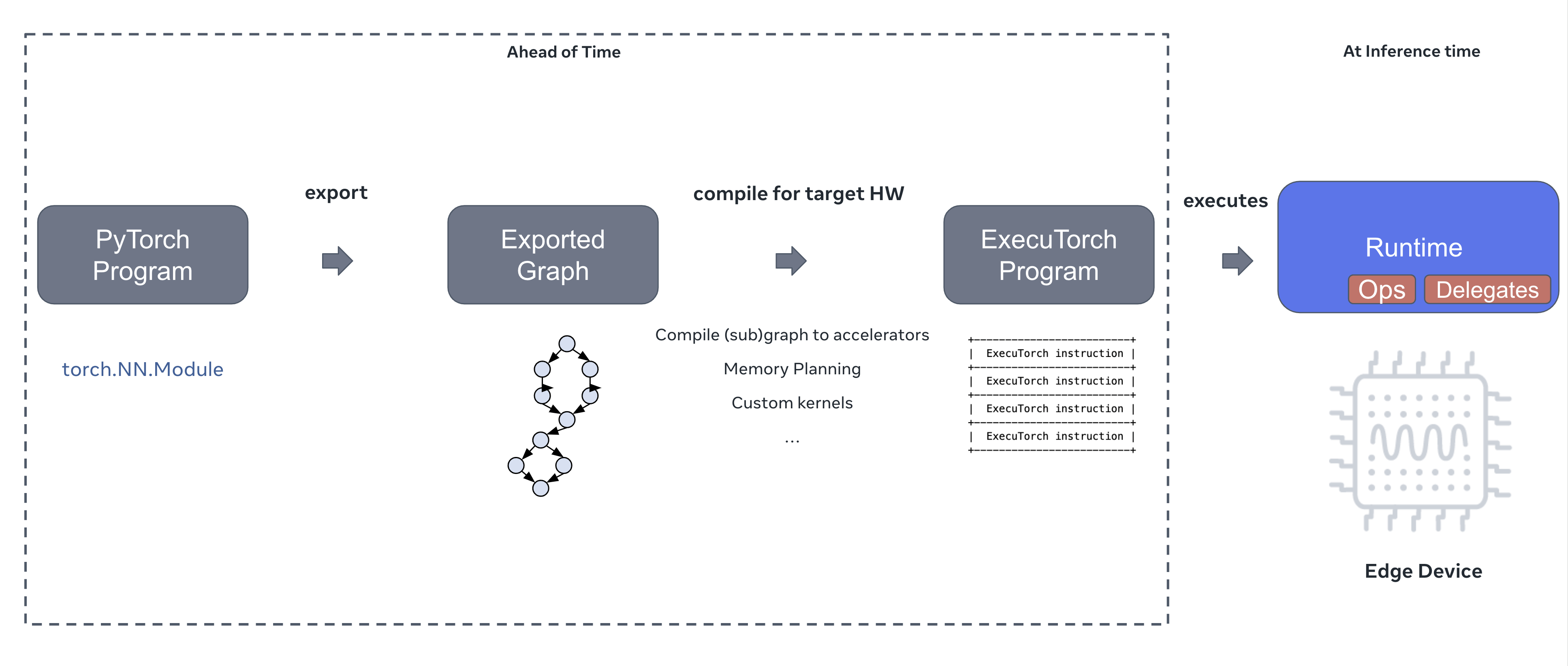
Figure 1. Ahead-of-time preparation and inference-time execution. Reproduced unchanged from the official ExecuTorch guide, asset revision September 25, 2023, retained in the inspected 1.5 documentation; BSD license.5
Export makes assumptions explicit
Export turns the model into a graph with a specified input contract.
An intermediate representation, or IR, gives tools a form they can inspect
and transform. Lowering moves the graph toward operations and formats
supported by the selected backend. In the inspected ExecuTorch 1.5 guide,
PyTorch export is followed by backend transformation and lowering, then
serialization to a .pte program.1
Check more than successful conversion. Preserve the tokenizer or input processor, normalization, layout, masking, special tokens and output interpretation. Test the exported model against the reference on representative inputs. A program that produces a tensor of the expected shape can still produce the wrong answer.
The export contract should state the supported batch, prompt length, image size or audio duration. A sample input used during export is not, by itself, evidence that arbitrary sizes work.
Shapes affect both optimization and memory
A static shape fixes tensor dimensions. A dynamic shape permits some to vary, often within declared bounds. Predictable shapes give a compiler more information; unrestricted variation can reduce optimization opportunities or require more complex allocation. ExecuTorch’s memory planner propagates tensor sizes and lifetimes and evaluates dynamic dimensions using their bounds.6
Consider a proposed image encoder accepting 224 × 224 and 448 × 448 inputs. A finite set of variants may fit the product better than accepting any resolution. Padding every image to the largest shape has a cost; generating many variants has package and maintenance costs. Core ML provides enumerated and ranged shapes, and documents that the first prediction for a non-default enumerated shape may be slower than subsequent predictions.7
For a decoder, distinguish the prompt-processing shapes from the one-position decode path and the growing cache. A runtime may use separate methods, buckets or fixed-capacity state. Test the transition at each supported boundary, including an empty or tiny input and the maximum permitted context.
Plan lifetimes, not just tensor sizes
Two buffers that are never live together can share storage. A simple teaching example has an 8 MiB intermediate that dies before a later 6 MiB temporary is created. Reusing its region requires 8 MiB, compared with 14 MiB if both receive separate storage. If the first tensor remains needed for a residual connection, that reuse is invalid. This is a local example of lifetime planning, not a measured saving for a model.6
Count persistent weights and attention state separately from the transient arena. Include backend allocations, input/output buffers and initialization peaks. A planner’s arena size does not establish the process’s total peak memory. See efficient inference for the KV-cache calculation.
Fusion and kernels change the physical work
Graph transformations can remove redundant nodes, fold constant computation and combine compatible operations. ONNX Runtime documents basic rewrites before partitioning and further fusions after provider assignment; which fusion applies depends on the graph and provider.4
For intuition, a separate matrix multiplication, bias addition and activation can require intermediate writes and separate dispatches. A fused implementation may keep intermediate values closer to the processor and avoid some of those costs. That is a candidate mechanism, not proof that a particular graph has been fused. Inspect the lowered graph and execution trace.
The same operator name can have very different performance at batch one versus a large batch, or for one token versus a long prompt. Check the actual precision, layout and kernel implementation. A 4-bit weight file does not imply 4-bit activation arithmetic throughout the program.
Partial acceleration can be expensive
A model may have two large accelerated regions separated by one unsupported operation. Executing that operation on the CPU can require synchronization, transfers or layout conversion at both boundaries. ONNX Runtime’s model usability checker reports both supported nodes and partition counts, and explicitly warns that switches between supported and unsupported regions can affect performance.8
Figure 2 isolates the costs that a supported-node percentage hides. The accelerated regions are separated by a CPU operation, so each crossing must be included in the complete path. The diagram and calculation use hypothetical serial timings; overlapping execution requires its own trace.
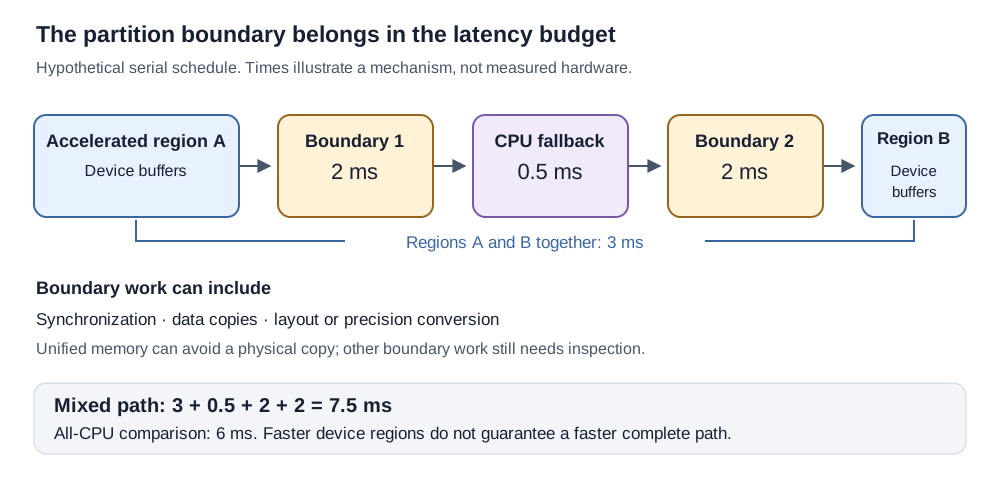
Figure 2. Faster regions, slower complete path. Latent Light illustrative derivation using the numbers below, informed by ONNX Runtime partition and I/O documentation; no device measurement.89
Use an illustrative serial schedule with 3 ms on an accelerator, 0.5 ms on the CPU and 2 ms at each of two boundaries:
If the measured all-CPU path were 6 ms, that partition would lose, despite its fast accelerator regions. These values are hypothetical. On unified-memory systems a boundary may not copy physical bytes, but synchronization, buffer ownership and format conversion still need inspection. Do not assume the example applies to every CPU/GPU/NPU combination.
ONNX Runtime’s I/O Binding documentation explains another boundary: inputs or
outputs not resident on a non-CPU provider’s target can be copied as part of
Run(). Keeping an appropriate buffer on the device can remove avoidable
round trips, provided the next consumer can use it there.9
Compare the boundaries, not a universal winner
The following comparison is a Latent Light synthesis of official material inspected October 12, 2026. Mutable guides describe supported paths, not an execution test of any model or device. Pin exact tool, SDK, driver and OS versions for a deployment.
Where each stack enters the deployment
7 paths| Path | Main boundary | Useful fit | What remains to verify |
|---|---|---|---|
| ExecuTorch | PyTorch export and lowering to a backend-specific .pte; unsupported portions may use CPU fallback.1 |
A PyTorch-based model pipeline with explicit backend preparation | Export semantics, delegation coverage, shape bounds and runtime build |
| LiteRT | .tflite model format and the CompiledModel execution API for targeted accelerators.10 |
A device ML pipeline using supported conversion and buffer APIs | Model operators, platform distribution and the selected accelerator |
| LiteRT-LM | An orchestration layer for LLMs running with LiteRT; current documentation includes multimodal and tool-use paths.11 | An application needing language-model sessions and generation integration | Specific model packaging, modality/backend coverage and SDK release |
| Core ML | Apple model conversion, platform runtime and configurable input shapes; stateful models can retain mutable state.712 | A deployment within supported Apple platforms | Deployment target, actual compute placement, supported shapes and state behavior |
| ONNX Runtime | ONNX graph execution through execution providers that claim supported nodes or subgraphs.2 | A pipeline using ONNX and provider-specific integration | Opset/kernel coverage, provider version, partition count and transfers |
| llama.cpp | C/C++ inference built on ggml, GGUF model artifacts and several CPU/accelerator backends.1314 | A supported local LLM/VLM with direct generation tooling | Model architecture and quantization support, backend build, offload choices and app lifecycle |
| Vendor backend or SDK | For example, ONNX Runtime’s QNN provider targets Qualcomm tooling and documents operator/data-type restrictions.15 | A known device family whose specialized execution path is worth testing | SDK/runtime compatibility, supported precision, compiler settings and distribution terms |
No matching paths. Try another term or reset the search.
Scroll to compare. Focus view gives the table more room.
These paths can overlap: an application-facing runtime may delegate to a vendor backend or another platform’s runtime. A general model runtime may also need a separate generation loop, tokenizer and multimodal preprocessing. Compare the same application boundary when deciding between them.
The LiteRT overview itself distinguishes platform packaging maturity: its inspected Apple-platform guidance separates the LiteRT-LM Swift package from the LiteRT runtime’s nightly Swift distribution. A cross-platform headline therefore does not establish identical packaging or feature maturity everywhere.10
Precision and state belong in the contract
Check storage precision, arithmetic precision and state precision separately. A backend may accept an operator only for selected data types or attributes. The QNN provider’s documented MatMul and Gather restrictions are examples of why an operator name alone is insufficient.15
State placement also matters. Core ML’s stateful model interface lets the model runtime update state without explicitly passing and copying it between every prediction. Its guide describes a KV-cache example and platform requirements; the interface is not proof that a particular conversion is optimal.12
Retain a compact deployment manifest: model/checksum, input processing and tokenizer revision, conversion command, runtime release, backend/SDK versions, OS and device, shape limits, precision, cache policy and fallback behavior. Keep the generated artifact tied to that manifest so a later compiler upgrade can be evaluated as a real change.
Debug from correctness to the execution trace
A useful proposed sequence is to confirm reference outputs, confirm converted outputs, inspect accelerated partitions, then profile the complete application path. When a regression appears, ask whether a graph rewrite, kernel, transfer, allocation or initialization changed.
Measure both cold initialization and repeated execution. Compare a reasonable CPU baseline to the candidate accelerator path. Test the maximum workload as well as the typical one. Preserve a fallback that satisfies the application’s quality and latency requirements rather than merely accepting any output.
Continue with evaluation and profiling to turn those checks into reproducible evidence, and production and product design for app lifecycle, release and recovery decisions.
References
-
PyTorch, Model Export and Lowering, ExecuTorch 1.5 documentation inspected October 12, 2026. The Export and Lowering Process and Hardware Backends sections; the stable URL is mutable. ↩ ↩2 ↩3
-
ONNX Runtime, Execution Providers, inspected October 12, 2026.
GetCapability()and subgraph assignment; mutable documentation. ↩ ↩2 -
PyTorch, Concepts, ExecuTorch 1.5 documentation inspected October 12, 2026. Kernel, lowering and memory-planning definitions. ↩
-
ONNX Runtime, Graph Optimizations, inspected October 12, 2026. Basic and Extended Graph Optimizations and Online/Offline Mode. ↩ ↩2
-
PyTorch contributors, How ExecuTorch Works, inspected 1.5 documentation on October 12, 2026. The high-level diagram is byte-identical to
how-executorch-works-high-level.pngat its original asset revision, September 25, 2023; copyright Meta Platforms and Arm, BSD license at that revision. ↩ ↩2 -
PyTorch, Memory Planning, ExecuTorch 1.5. Overview: tensor sizes, lifetimes, fixed arenas and dynamic shape bounds. Inspected October 12, 2026. ↩ ↩2
-
Apple, Flexible Input Shapes, Core ML Tools guide inspected October 12, 2026. EnumeratedShapes, ranged dimensions and default-shape preallocation. ↩ ↩2
-
ONNX Runtime, Model Usability Checker, inspected October 12, 2026. Supported/unsupported operators, dynamic-shape caveats, partition counts and required performance testing. ↩ ↩2
-
ONNX Runtime, I/O Binding, inspected October 12, 2026. Target-device inputs and outputs and copies inside
Run(). ↩ ↩2 -
Google, Getting started with LiteRT, inspected October 12, 2026. Model format, CompiledModel examples and the platform-specific installation guidance; mutable documentation. ↩ ↩2
-
Google, LiteRT-LM Overview, inspected October 12, 2026. Orchestration, supported platform families, modalities and tool use; specific release/model combinations still require verification. ↩
-
Apple, Stateful Models, Core ML Tools guide inspected October 12, 2026. State inputs, conversion, platform availability and KV-cache example. ↩ ↩2
-
ggml-org, llama.cpp README, master branch inspected October 12, 2026. Description and Supported backends; moving branch, not a pinned deployment build. ↩
-
ggml-org, Obtaining and quantizing models, master branch inspected October 12, 2026. GGUF requirement and conversion tools. ↩
-
ONNX Runtime, Qualcomm QNN Execution Provider, inspected October 12, 2026. Provider options and Supported ONNX operators, including per-operator data-type and attribute restrictions. ↩ ↩2
