“Efficient attention” can mean faster execution, a smaller record of each token, fewer positions read, or a different memory altogether. These choices solve different problems. Start with what is stored and what a query can read, then ask how the operation runs.1234
Four memory contracts
Explicit history
Store keys and values by position. GQA reduces the number of KV heads, not the number of retained positions.
Compressed history
MLA retains a compact content latent plus a positional key for each token. The history still grows.
Selected reads
An indexer selects tokens or blocks before the main attention operation. Unselected history may still occupy storage.
Recurrent state
Update a fixed-shape state instead of appending one record per token. Earlier details must survive compression.
FlashAttention is a separate execution choice: it avoids a full score matrix in HBM without removing dense pairwise arithmetic.
Figure 1. Retaining history and reading history are different decisions. Original synthesis; cells and selected rows are illustrative.2354
The four panels in Figure 1 are not interchangeable replacements. A model can combine compressed history, sparse reads, and recurrent layers. An exact attention kernel can improve the remaining softmax operation without changing those architectural choices.
Execute the same operator more efficiently
FlashAttention brings tiles of queries, keys, and values into fast on chip memory, updates softmax statistics incrementally, and avoids materializing the full score matrix in high bandwidth memory. Backward recomputation replaces storage of that matrix.1
It preserves dense softmax attention, subject to numerical differences. The pairwise arithmetic remains quadratic in sequence length. Kernel speed, attention workspace, persistent KV cache, and total model memory are distinct measurements. A kernel improvement is not a proof that the model retains less history.
Share heads or compress content
GQA shares a key head and value head within each query group. MQA uses one KV group; ordinary MHA uses one per query head. None removes positions from the retained prefix.2
For equal key and value head widths, a local tensor count gives:
Here L is layer count, B batch size, T retained positions, HKV KV heads, dh elements per head, and s bytes per element. This counts keys and values only, excluding runtime overhead. Reducing KV heads by four reduces this storage by four, not necessarily latency by four.
MLA instead jointly compresses content keys and values into a latent for each token. DeepSeek-V2 also retains a separate positional key. Suitable projection absorption allows an optimized implementation to read the latent without reconstructing every old head representation.3
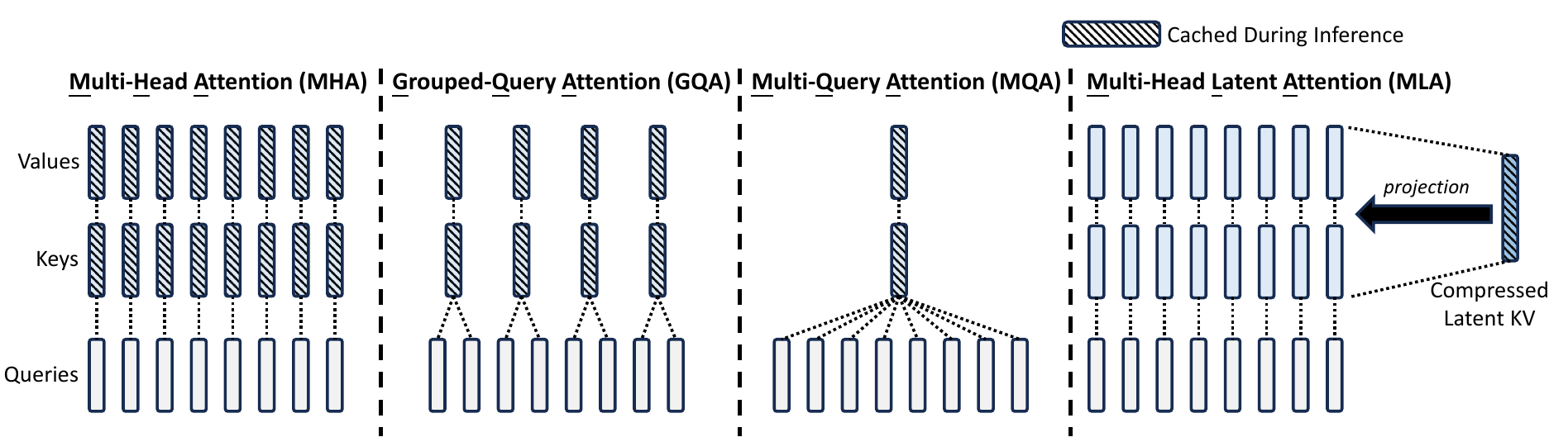
Figure 2. Sharing heads versus compressing content. Reproduced from DeepSeek-AI, V2 documentation Figure 3; unchanged figure crop, MIT notice.3
Figure 2 is a simplified content view. MLA’s separate positional key belongs in the complete cache count. Its history still grows with T. The V2 study also documents why a reference implementation and an optimized latent cache need not store the same tensors.
Restrict which history participates
A sliding window changes connectivity: each layer reads a bounded recent region. Older information can travel through intermediate representations across depth, but an arbitrarily distant token is not directly visible to every layer. Mistral 7B supplies a concrete example.6
Learned sparse attention adds a different choice. A cheaper indexer selects history, then the main attention reads selected tokens or blocks. GLM-5 uses DSA; MiniMax Sparse Attention selects blocks separately for GQA groups.75 Selection can reduce expensive reads while leaving growing storage and indexing work. “Exact attention on selected entries” is not the same operator as dense attention over every entry.
For compressed and selected history together, continue with DeepSeek-V4 or Qwen3.8-Next.
Replace an append-only history with state
The causal linear Transformer writes key and value associations to a matrix. Using column vectors, a positive feature map φ, and zero initial states:4
The denominator must be nonzero. With feature width dφ and value width dv, the state contains dφdv + dφ elements, independent of T. This is a different matching operator, not exact softmax attention in another order.
Mamba uses a selective state space model: input dependent dynamics control what survives and how it is read.8 Kimi Linear adds corrective writes and channel specific forgetting. These are distinct update rules, not synonyms for the additive recurrence above.9
Hybrids preserve more than one kind of history
Kimi Linear · 3 KDA : 1 MLA
KDA layers retain fixed-shape recurrent state; periodic global MLA layers still retain growing token history.
Gemma 3 · 5 local : 1 global
Local layers keep a bounded attention window; periodic global layers retain full history. Local attention is not recurrence.
R: recurrent KDA. L: local window. G: global MLA or softmax, as named above. These layer patterns are not interchangeable definitions of hybrid attention. FFNs and residuals are omitted.
Figure 3. Fixed or bounded local state can coexist with growing global history. Original comparison of the named reports’ layer patterns.910
The global path in Figure 3 still grows with context. Do not assign a recurrent layer’s fixed state to the entire hybrid model. MiniMax 01 provides another instructive hybrid, with seven lightning layers before each softmax layer.11
Compare the right budgets
Report quality, prefill latency, decoding latency, persistent state, peak workspace, total weights, and throughput at a stated concurrency. Control hardware, precision, lengths, and backend. Inspect retrieval under distance and distractors, not only easy recent facts.
This is a proposed measurement framework, not a benchmark result. Selected mechanisms rechecked October 10, 2026. For the original attention shapes, see Foundations.
References
-
Tri Dao et al. FlashAttention, 2022, sections 2 and 3. Dense exact attention is separate from the block sparse extension. ↩ ↩2
-
Joshua Ainslie et al. GQA, 2023, section 2. Equation (1) is a local KV tensor count. ↩ ↩2 ↩3
-
DeepSeek-AI. DeepSeek-V2, 2024, sections 2.1.2 to 2.1.4 and Appendix B. Source Figure 3 is reproduced from the matching repository documentation edition; the complete MLA includes the positional key. ↩ ↩2 ↩3 ↩4
-
Angelos Katharopoulos et al. Transformers are RNNs, 2020, section 3. Equation (2) restates the normalized causal recurrence with local notation. ↩ ↩2 ↩3
-
MiniMax. MiniMax Sparse Attention, 2026, sections 2.2 and 3: group specific block selection and index cost. ↩ ↩2
-
Albert Q. Jiang et al. Mistral 7B, 2023, section 2. ↩
-
Kimi Team. Kimi Linear, 2025, sections 3, 4 and 6: KDA and the 3:1 hybrid. ↩ ↩2
-
Gemma Team. Gemma 3 Technical Report, 2025, local/global attention design and memory ablations. ↩
-
MiniMax. MiniMax-01, 2025, section 2.2: lightning and hybrid attention. ↩