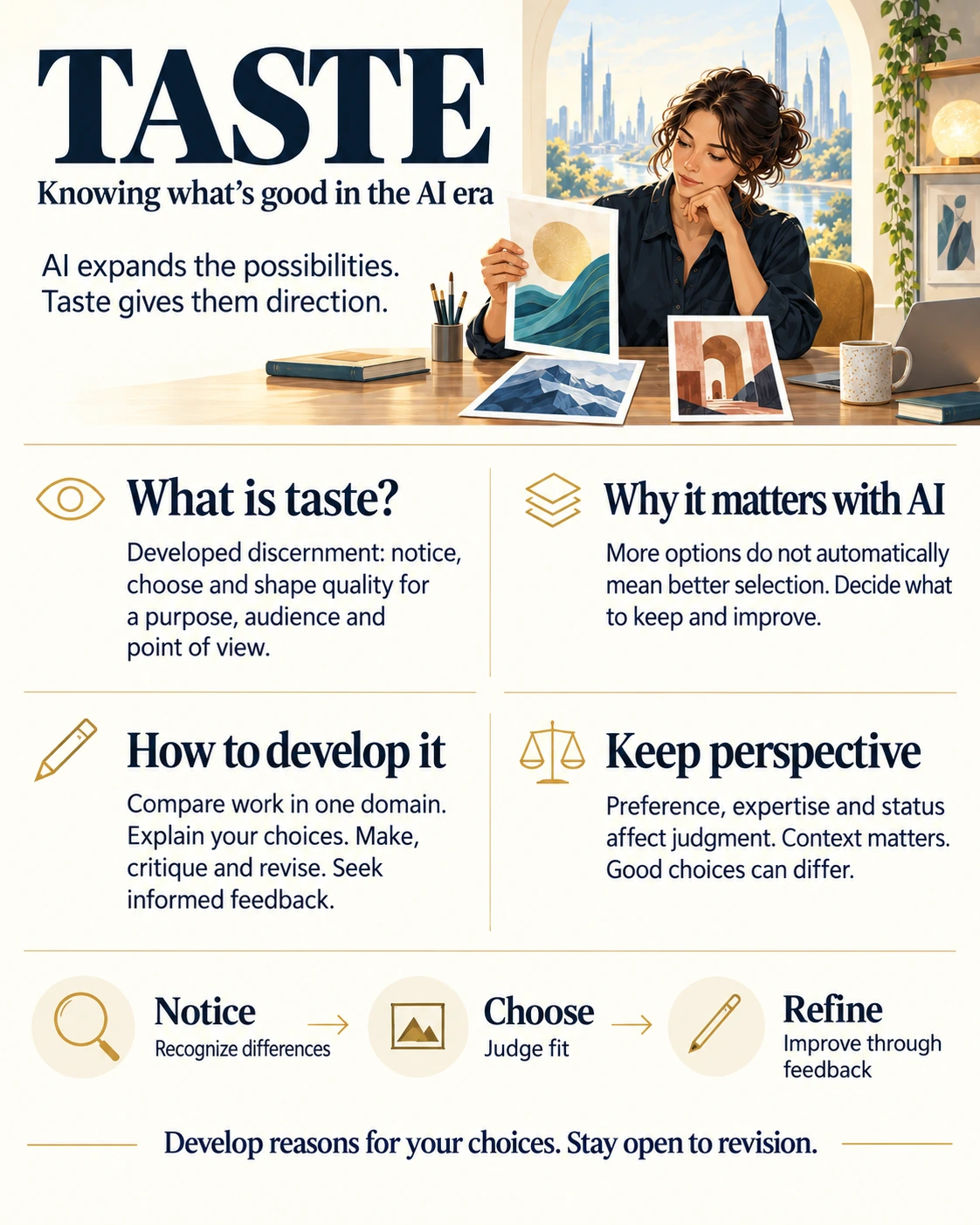
Figure 1. Taste in the AI era. AI-generated editorial infographic of Latent Light’s working definition, AI selection challenge, proposed practice and contextual limits.12345
Read the overview
What it is — recognize and shape quality. Notice what matters, choose among alternatives, and refine work for a purpose, audience and point of view.
Why it matters with AI — more possibilities need direction. Better generated options do not automatically mean better selection. Decide what is worth keeping and improving.
How to develop it — compare, make, critique, revise. Study a particular domain. Explain your choices, test them through making, and learn from informed feedback.
What to remember — context and disagreement matter. Preference, expertise and status can all affect a judgment. A coherent choice can differ from someone else’s.
The working loop is notice → choose → refine: recognize differences, judge fit, and improve through feedback.
Develop reasons for your choices while remaining open to revision.
You have twenty possible designs, three polished drafts, and an AI tool ready to produce more. Which version should you keep? What should you change? What would make the result worth someone’s attention?
For this guide, taste is developed discernment expressed in what you notice, choose, and shape. It involves recognizing quality in a particular domain and making choices that fit a purpose, an audience, and a point of view. This working definition combines ideas about making and evaluative judgment; it is a synthesis, rather than a single established psychological trait.12
The opportunity with AI is to direct additional capability toward work you consider worthwhile. The challenge is that generating something impressive, recognizing its quality, and choosing what to develop are different activities. Taste helps you examine those choices. It offers no guarantee of success or protection from changes in employment.
What we mean by taste
The word carries several meanings. “I like it” reports a preference. “This works well for these readers” makes a judgment that needs reasons. “I would change this opening” turns a judgment into a making decision. They can inform one another, but they answer different questions.
| Meaning | Focus |
|---|---|
| Personal preference | What attracts, moves or interests you: a restrained design, an exuberant one, a particular kind of story. |
| Aesthetic appreciation | How form, rhythm, composition, surprise or meaning contribute to your experience. |
| Evaluative judgment | How well work meets relevant standards and intentions, including the quality of your own work.2 |
| Taste in making | Which possibility to pursue, what to retain, and how to refine the whole. This is the guide’s practical emphasis. |
An editor may admire an unusual sentence while removing it because it disrupts the passage. A designer can appreciate an elaborate poster and choose a simpler invitation for someone scanning a community noticeboard. These are original illustrations of judging work in context. Having a preference does not require winning an argument about universal superiority.
An old problem in a new conversation
Taste is visible in 2026 technology coverage.6 Anthropic’s 2026 trends report also describes engineers retaining design choices that require context or taste. It is a commercial report containing predictions and self-described practice, not an independent experiment proving taste’s economic value. These sources establish attention in that community, not a measured growth rate in public interest.7
The underlying question is much older. In Of the Standard of Taste, David Hume argued that practice, comparison and attention free from prejudice can improve criticism. He also acknowledged differences in temperament and context that need not be faults. This is a philosophical argument, with historical assumptions about who qualifies as a critic; it is not experimental proof of one universal standard.8
Paul Graham’s 2002 Taste for Makers approaches the problem through creating things. He argues that taste can improve as makers gain knowledge, recognize weaknesses, and redesign their work. It is a useful practitioner perspective, whose proposed principles should be examined in a particular domain.1
Shared standards and personal differences
There are choices we can discuss against a stated aim: whether someone can find an event’s time, whether a claim is supported, or whether a paragraph explains the idea it promises. There are also choices for which informed people can prefer different rhythms, forms, or emotional effects. A useful approach is to make the relevant standard explicit before treating disagreement as a mistake. This distinction is a practical interpretation of evaluative judgment and research on aesthetic preferences.24
Vessel and colleagues compared preferences across visual domains in two experiments. Participants agreed more about faces and natural landscapes than about artworks and architecture. The second experiment compared landscapes with exterior architecture within the same people, finding a difference in agreement without a difference in rating reliability. A person can have a repeatable preference that others do not share. The study does not establish standards for every culture, medium or professional task.4
Figure 2 makes that distinction concrete. Both invitations describe the same fictional event. First consider this brief: help neighbours understand what the workshop offers and find the practical details quickly. Which version would you choose, and what feature supports your choice?
Bring an unfinished idea. Try a first version together.
- Community workshop
- Saturday · 2 pm
- Studio A · Free
Bring an unfinished idea. Try a first version together.
- Community workshop
- Saturday · 2 pm
- Studio A · Free
Figure 2. Original fictional invitations with the same event facts and different visual emphasis. Latent Light illustration of judging work in context; no audience experiment or universal winner is implied.24
Compare the choices, then change the brief
Version A puts the activity in the headline and uses a straightforward reading order. That may suit a practical invitation. Version B gives more space to an expressive phrase and a visual motif. It could suit a brief that prioritizes identity and a memorable impression. Those are design interpretations, not measured effects.
Now change the brief: imagine an established creative group seeking an invitation that expresses its character, with members already familiar with the format. Your preferred version or proposed revision might change. You could also retain Version B’s expressive identity while bringing its event details forward. Neither brief obliges everyone to make the same aesthetic choice.
The useful move is to name a feature, connect it to an intention, and recognize its tradeoff. “The activity is clear in the headline” gives a collaborator something to examine. “It has better taste” leaves the reasoning hidden.
How a judgment forms
You learn what to notice
Perceptual learning research studies changes in the information people extract from experience. Kellman and Massey distinguish discovering relevant structure from becoming faster and more fluent at recognizing it. Their review includes specific learning tasks, such as mathematical representations and visual classification. It does not directly test a general programme for creative taste.9
A practical extrapolation is to practise noticing relationships within one domain: the sequence of ideas in an explanation, the relative prominence of information in a layout, or how a product’s details support its main use. Rather than collecting admired examples without examining them, ask what you can now distinguish that you previously missed.
Some recognition can become quick without being easy to explain. That does not make every quick reaction expert. Kahneman and Klein argue that reliable intuition needs an environment with learnable regularities and an opportunity to learn them; subjective confidence alone does not establish accuracy. Applied here, confidence in choosing a poster is a reason to examine your experience and feedback, not a credential that settles the choice.10
Feeling and appraisal can separate
Leder and colleagues’ model of aesthetic appreciation includes perception, classification, interpretation and evaluation. It distinguishes aesthetic emotion from aesthetic judgment. The model helps explain why understanding what a work is attempting can contribute to appreciation. It is a theoretical account of aesthetic processing, not a complete settled explanation of taste.11
For example, you might find a work uncomfortable while admiring how precisely it creates that experience. You might enjoy a familiar style while recognizing that it does little for the task at hand. These examples illustrate a distinction between your response and your appraisal; neither response needs to be concealed.
Reber, Schwarz and Winkielman’s processing fluency account links ease of processing with aesthetic pleasure. Their review considers repetition, contrast, symmetry and other influences, while noting roles for expectations and how people attribute the experience. This helps explain some immediate appeal; it does not establish that familiar, symmetrical or simple work is always best.12
A practical implication is to look again after the first impression. Ask what remains interesting, what becomes clearer with attention, and whether a pleasant surface supports the work’s purpose.
Social context enters the choice
In Distinction, Pierre Bourdieu treats taste as acquired ways of classifying and appreciating, shaped by social position and socialization. The inspected conclusion offers a historical sociological account of how preferences can express membership and distinction. It should not become a claim that every choice is explained by class or that one group’s taste is inherently superior.5
Experimental work also shows that appraisal is sensitive to context. Salganik, Dodds and Watts created an online music market with 14,341 participants and 48 unfamiliar songs. Randomly assigned participants either saw previous download choices or chose independently. Stronger social influence increased inequality and unpredictability in downloads. Their quality proxy was popularity in the independent condition, not objective musical merit. Market success therefore cannot simply be read as a verdict on artistic quality.13
Bellaiche and colleagues randomly labeled AI generated paintings as human or AI created. Across two studies, the human label produced higher ratings. The manipulation concerns beliefs about origin, not an actual comparison of human and AI creation. Origin can itself be a legitimate part of what people value; the finding shows that judgments involve more than visible form.14
A useful self-check is to state both the object and the context you are judging: “I like this composition” and “I value how it was made” are claims you can examine separately. Removing names or popularity counts for an initial comparison can help you investigate your reasons, although this exercise is a proposal, not a proven way to eliminate bias.
Why taste matters in the AI era
The strongest case is about directing, selecting and refining possibilities. AI can assist with producing work, yet a productive workflow still needs an account of what the work is for and how to assess it. This is our interpretation of the evidence below; these studies do not measure a single “taste advantage” that transfers to every task.
Better output and better selection are different
In the published Procter & Gamble experiment, 791 professionals completed a one day product innovation workshop with or without GPT‑4 assistance, alone or in pairs. All conditions generated five initial ideas before selecting one. AI improved the quality of generated ideas, but did not improve selection of the highest rated idea. Teams without AI selected their best idea approximately 50% of the time, compared with roughly 37% in the AI conditions.3
Selected ideas with AI were still better in absolute quality: the improved set of options compensated for the weaker selection pattern. The experiment does not establish that AI makes all human judgment worse, or isolate why selection differed. It shows why output quality and selection ability should be evaluated separately.3
For your own project, compare whether AI improves the available drafts with whether you can recognize which draft serves the brief. Those can call for different improvements: more useful alternatives, clearer criteria, a second reviewer, or feedback from the people the work is meant to help.
More polish can coexist with less diversity
Doshi and Hauser’s experiment involved 293 writers producing eight sentence stories and 600 separate evaluators. Writers could receive GPT‑4 starting ideas, or write without that assistance. Access to AI ideas improved ratings of creativity, writing and enjoyment, particularly for writers with lower initial creativity scores. Yet assisted stories became more similar to one another. These results concern a constrained writing task, not all art or every current model.15
One practical response is to explore several directions before committing. Bring your own observations, constraints and references into the work. Compare what distinguishes the alternatives as well as what makes each acceptable. This is a proposed response to the diversity finding, not a tested recipe that guarantees originality.
Make the standard part of the collaboration
“Make it better” leaves much unspecified. A more useful brief might identify who will encounter the work, what they should understand, what tone fits, and what must be accurate. AI can help generate contrasting options or articulate possible weaknesses. You still need to decide whether those criticisms matter for your project and test important assumptions with appropriate evidence.
For a factual explanation, clarity and style need to accompany correctness. For an invitation, visual coherence needs to accompany accurate details. For a product, the experience needs to serve the people using it. These are proposed ways to make judgment discussable, rather than a universal quality formula.
Can AI learn taste?
Some evaluative preferences can be modeled, and some tasks remain difficult. Two 2026 investigations show why the answer depends on what is judged, whose preferences supply the labels, and what counts as success.
In the August version of AI Can Learn Scientific Taste, Tong and colleagues train models using community signals, including citations, to learn preferences over scientific work. They report improvements against strong model baselines and transfer to later papers and other evaluations. Citations are imperfect proxies for scientific value. Their generated ideas are mainly judged by other models and are not experimentally validated. This is a preprint about bounded scientific evaluation, not evidence of universal aesthetic discernment.16
Anthropic’s August TASTE evaluation asks models to choose between AI safety research proposals using experienced researchers’ preferences as labels. Its best tested model, Fable 5, scored 60%, compared with an estimated 77% human agreement. The benchmark contains 92 filtered pairs drawn from 50 proposals, with ten researchers contributing judgments. Filtering for confident agreement and repeated proposals limits generalization. Agreement with those labels is not the same as discovering an objective best research direction.17
These results use different tasks and metrics, so their scores should not be combined or compared as a ranking of general taste. They give reasons to investigate what can be learned and delegated, while retaining uncertainty. They do not support a claim that taste will remain permanently exclusive to humans. The human task includes deciding the aims and standards of a particular project, including values that an evaluation metric might omit.
How to develop your taste
The practices below are proposals informed by the research. The assembled approach has not been validated as a programme that improves a general taste score. Pick one domain and a real piece of work so that the choices have something concrete to answer to.
1. Write the brief before collecting options
Name the intended audience, the purpose, and a few relevant constraints. For a workshop invitation: “Help a neighbour decide whether to attend, show what happens, and make the practical details easy to find.” For a paragraph: “Help a newcomer explain the central idea accurately.”
Add a point of view when appropriate: warm, playful, restrained, unsettling, or exploratory. Keep it connected to the purpose. A brief gives you reasons for choices without requiring every project to have the same style.
2. Build a small library you can explain
Choose a few examples from your domain, including work outside your usual preferences. Record a feature, its effect, and a tradeoff: “The opening gives me a concrete situation before introducing the concept, but postpones the formal definition.” Return to the whole work so that you see how the parts fit.
Educational research on evaluative judgment proposes using exemplars, comparison and commentary to develop an understanding of quality. An admired example is more useful when you examine its decisions; merely collecting it does not show what you have learned.2
Include work you initially misunderstood and examples that suit a different brief. The aim is to increase what you can notice and discuss, while leaving room for your preferences to change.
3. Compare before reading someone else’s verdict
Put two alternatives against the same brief. Write your initial preference, a specific reason, and your uncertainty. Then read another person’s analysis or ask for feedback. Notice whether it reveals something you missed or simply values a different outcome.
Try hiding author names, AI labels or popularity signals during a first pass, then restore them and examine what changes. The label and social-influence studies motivate that experiment; they do not prove that blind comparison is always the right evaluation method.1413
4. Turn a criticism into a revision
Replace a vague verdict with a diagnosis you can act on. “This feels generic” might become “The invitation gives an ambitious promise but does not say what we will actually do.” Then make one change that addresses the diagnosis. Figure 3 shows an original example.
Join our transformational gathering as we unlock limitless potential and redefine what is possible.
Bring one unfinished idea. We’ll spend 30 minutes trying a first version and asking one another what to improve.
Figure 3. An original fictional writing revision. The second passage specifies an activity and a time boundary; it also changes the tone. This illustration is not a measured test of which invitation people prefer.
Read the editing diagnosis and tradeoff
The first version communicates ambition, but provides little basis for deciding what participation involves. The revision gives the reader an object to bring, an activity, and a time boundary. It makes a more limited offer that could be checked against an actual event plan.
Several things changed at once: wording, specificity, promise and tone. Consequently, this pair cannot isolate why a real audience might prefer one. If you want to investigate the effect of tone, hold the event information constant and compare two ways of expressing it. Then ask intended readers what they understood or expected, as well as which version they liked.
Compare the revision with the brief and the whole piece. A sentence can improve on its own while weakening the rhythm of the surrounding passage. A detail can become more prominent while competing with another important detail. Making exposes those tradeoffs in a way that an abstract verdict leaves hidden.
5. Seek feedback that can teach you something
Ask a knowledgeable person what they notice, and ask an intended reader or user what they understand or experience. These people can provide different kinds of information. “Which sentence made the promise unclear?” or “What do you expect to do at the workshop?” gives you more to examine than a request for a general score.
A meta analysis of 54 experimental and quasi-experimental peer assessment studies found a small to moderate average benefit to academic performance. The studies often combined giving and receiving feedback, so they do not isolate which activity caused the benefit. Outcomes and methods also varied. This supports examining critique as a learning activity, while leaving its transfer to broad creative taste uncertain.18
Keep a record of what you expected and what feedback revealed. Look for recurring mistakes and improvements within the same domain. Reliable learning needs opportunities to discover whether your judgment was useful; confidence and accumulated time alone do not establish that.10
6. Use AI as a participant in evaluation
Ask for alternatives that differ in a named way, or for critiques against specified criteria. Make an initial judgment yourself before comparing it with the tool’s analysis. Require reasons that refer to the actual work. An illustrative instruction is:
Compare these versions for a neighbour considering a beginner workshop. Check clarity of the activity, accuracy of the details, and tone. Give a reason tied to each version. Identify a tradeoff and an uncertainty. Suggest one revision that preserves what is working.
This is a proposed prompt, not a validated training method. Examine the critique as carefully as the draft: a confident explanation can rely on the wrong assumption or prefer a style that does not serve your audience. Use appropriate factual checks, specialist review or audience feedback for important decisions. AI assisted generation and selection remain separate things to evaluate.316
A small practice experiment
Choose one real artifact, such as an invitation, an explanation or a product screen. The sequence below is an original proposal, not an experimentally tested taste programme or a promise of rapid transformation.
| Session | Practice and record |
|---|---|
| Define and notice | Write a brief. Study three relevant examples. Record a feature, a reason and a tradeoff for each. |
| Compare and commit | Produce or collect two alternatives. Choose one before reading outside commentary. Record your reason and uncertainty. |
| Revise and check | Make a specific revision. Obtain informed critique or feedback from an intended reader. Record what matched or challenged your expectation. |
| Revisit | Review the whole artifact against the brief. Decide what to retain, change or investigate next. Keep the earlier version so the difference is visible. |
Look for concrete changes: you can identify a problem more precisely, explain a choice, revise a weak passage, or anticipate a reader’s misunderstanding. These are informal observations of progress, not a validated measure of taste. You may also discover a genuine preference difference that needs negotiation rather than correction.
Taste and agency work together
High agency emphasizes choosing a direction, taking a bounded step, and learning from what happens. Taste concerns the quality and character of the choices you make along that path. One can give the other something to work with: making creates material to judge, and judging helps you decide what to make next. This is a practical connection between the two guides, not a demonstrated multiplication of personality traits.
The aim is to become more attentive, more capable of explaining and revising your choices, and more responsive to what the work is for. Keep your own preferences available for examination, and give other people room to value different things. A considered point of view can coexist with curiosity.
References
-
Paul Graham. Taste for Makers, February 2002. Sections on redesign, problem fit and knowledge of a field. ↩ ↩2 ↩3
-
Joanna Tai, Rola Ajjawi, David Boud, Phillip Dawson, and Ernesto Panadero. Developing evaluative judgement: enabling students to make decisions about the quality of work, Higher Education 76, 2018, pages 467–481; published online December 16, 2017. Definition and sections on exemplars and rubrics. ↩ ↩2 ↩3 ↩4 ↩5 ↩6
-
Fabrizio Dell’Acqua et al. The Cybernetic Teammate: A Field Experiment on Generative AI and Teamwork, Organization Science 37, 2026, pages 1217–1242. Published June 12, 2026; Section 3, Section 5.4.1 and Figure 8. ↩ ↩2 ↩3 ↩4
-
Pierre Bourdieu. Classes and Classifications, selected conclusion from Distinction, Richard Nice’s English translation, 1984, pages 466–484; original French book 1979. Opening and sections on embodied social structures and knowledge without concepts. ↩ ↩2
-
Megan Morrone. AI’s taste test, Axios, April 19, 2026. ↩
-
Anthropic. 2026 Agentic Coding Trends Report, 2026, foreword and pages 5–6. Commercial report and predictions. ↩
-
David Hume. Of the Standard of Taste, 1757, Hume Texts Online edition. Sections ST 18–23 and ST 28–30. ↩
-
Philip J. Kellman and Christine M. Massey. Perceptual Learning, Cognition, and Expertise, Psychology of Learning and Motivation 58, 2013, pages 117–165. Pages 120–122 and 154–158. ↩
-
Daniel Kahneman and Gary Klein. Conditions for Intuitive Expertise: A Failure to Disagree, American Psychologist 64, 2009, pages 515–526. Conditions for skill, feedback and confidence, especially pages 521–523. ↩ ↩2
-
Helmut Leder, Benno Belke, Andries Oeberst, and Dorothee Augustin. A model of aesthetic appreciation and aesthetic judgments, British Journal of Psychology 95, 2004, pages 489–508. Publisher abstract and proposed model. ↩
-
Rolf Reber, Norbert Schwarz, and Piotr Winkielman. Processing Fluency and Aesthetic Pleasure: Is Beauty in the Perceiver’s Processing Experience?, Personality and Social Psychology Review 8, 2004, pages 364–382. Processing ease, expectations and attribution, especially pages 364–366. ↩
-
Lucas Bellaiche et al. Humans versus AI: whether and why we prefer human-created compared to AI-created artwork, Cognitive Research: Principles and Implications 8, 2023, article 42. Abstract and Study 1 and Study 2 label manipulations. ↩ ↩2
-
Anil R. Doshi and Oliver P. Hauser. Generative AI enhances individual creativity but reduces the collective diversity of novel content, Science Advances 10, July 12, 2024, eadn5290. Experimental design, results and discussion. ↩
-
Jingqi Tong et al. AI Can Learn Scientific Taste, arXiv:2603.14473v3, August 19, 2026. Preprint; evaluation design and Limitations and Future Work. ↩ ↩2
-
Hasan Baig, Hailey Joren, and Joe Benton. TASTE: Can AI Models Judge AI Safety Research Proposals?, August 28, 2026. Research report and linked manuscript; benchmark construction and Section 6 limitations. ↩
-
Kit S. Double, Joshua A. McGrane, and Therese N. Hopfenbeck. The Impact of Peer Assessment on Academic Performance: A Meta-analysis of Control Group Studies, Educational Psychology Review 32, 2020, pages 481–509; published online December 10, 2019. Abstract and Limitations. ↩