A smart device does not need to understand everything it senses. It can identify useful events, read a region or check an action, while a stronger cloud agent connects that evidence to the user’s goal.
The promising pattern is local perception and bounded execution, guided by cloud reasoning. Google Home describes a camera architecture that sends locally selected keyframes and metadata to its cloud. EcoAgent studies a cloud planner with smaller mobile execution and observation models. These are related designs, but their evidence and hardware readiness differ.12
This page explores glasses, phones and cameras. For the general architecture, tool contracts and permission boundaries, read Cloud Agents & Local Specialists. For routing and other forms of cooperation, start with the Local & Cloud AI overview.
Where the computation lives
“Local” needs a location. A model running on glasses, a paired phone and an edge GPU server has a different power, memory and connectivity budget. Qualcomm discusses both standalone glasses and designs connected to a phone or nearby computing puck. NVIDIA documents vision agents on edge platforms such as AGX Thor and DGX Spark.34
Figure 1 shows a possible allocation, not one product’s internals. The middle tier is optional: its responsibilities can move to the device when resources allow. Disclosure checks must remain local in either case.
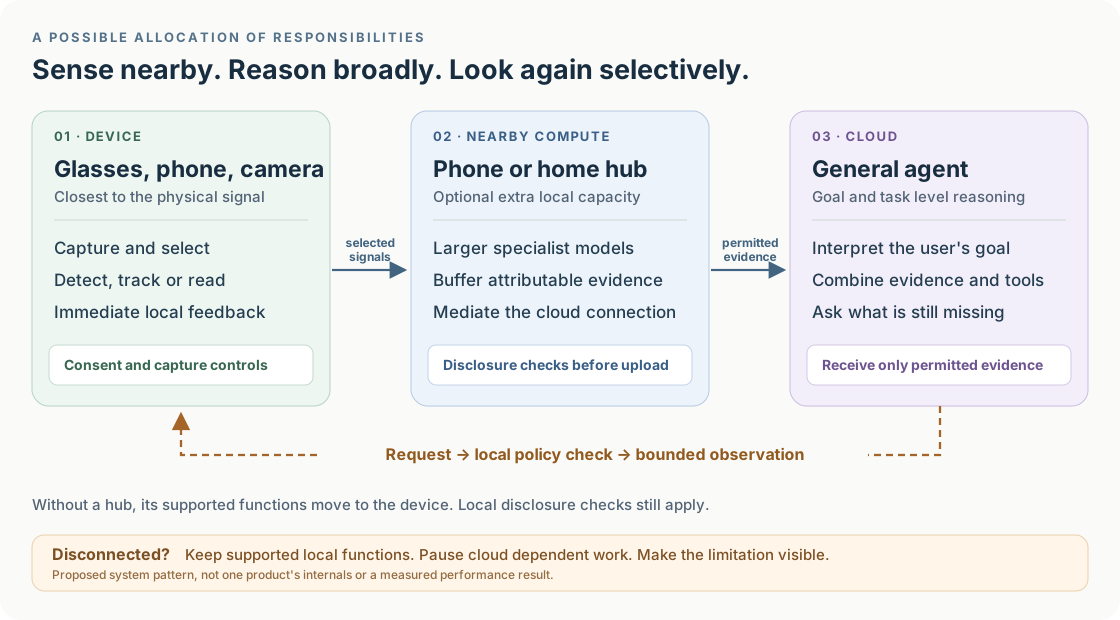
Figure 1. Three places to compute, with a deliberate disclosure boundary. Independent synthesis informed by device platforms and modular cloud reasoning.315
The text equivalent is:
- Device: capture, lightweight detection or tracking, local consent and capture controls, and immediate feedback.
- Phone or home hub, when used: larger specialists, temporary evidence buffers, policy checks and the cloud connection.
- Cloud agent: interpret the goal, combine permitted observations, use remote tools and request more evidence.
- Return path: validate each request locally before capturing, disclosing or acting. A cloud request is not authority to bypass consent.
- Disconnection: preserve only the functions explicitly supported locally; do not silently promise that cloud reasoning remains available.
These are proposed responsibilities, not a requirement that every system contain three machines or three language models.
Research, platforms and products
Selected primary sources rechecked October 20, 2026. Read the final column as carefully as the capability column. A proposed architecture, a configurable framework and a consumer feature establish different things.
What actually runs where?
6 examples| System | Device or nearby computation | Cloud contribution | Evidence boundary |
|---|---|---|---|
| Intention-aware AI glasses, April 2026 | Task selected visual preprocessing | Infer intention and reason over retained information | Simulation study, not measured wearable deployment.6 |
| EcoAgent, AAAI 2026 | Smaller execution and observation models | Plan and replan mobile tasks | Mobile inference simulated on a server GPU.2 |
| NVIDIA VSS 3.2.1 | Configurable local VLM | Configurable remote reasoning LLM | Documented configuration; edge hardware is not necessarily inside the camera.54 |
| Google Home camera platform | Select keyframes and metadata | Camera understanding and Gemini features | Disclosed commercial platform split, not a published agent benchmark.1 |
| Meta AI glasses Private Processing, September 2026 | Some everyday functions stay on the device | Larger personal AI workloads | Engineering disclosure; visual specialist placement is not fully specified.7 |
| Ring and Alexa+ Greetings | Local visual placement not disclosed | Visual context informs visitor conversation | Announced consumer feature, not proof of a local vision model.8 |
No matching examples. Try another term or reset the search.
Scroll to compare. Focus view gives the table more room.
This is a map of documented mechanisms, not a ranking or an exhaustive product catalog. Availability also depends on device, region, software and subscription.
Glasses: decide what deserves attention
Task directed perception
The intention-aware glasses paper proposes a cloud VLM that selects local preprocessing: OCR for text, Canny boundary detection for document regions, or YOLO for objects. It studies intermittent images and semantic transmission, not unrestricted continuous video.6
Its results also reveal the risk of overcompression. In its document QA comparison, success is 44% with OCR text versus 78% with JPEG images. Removing the image can remove spatial relationships needed for the answer. The study uses simulated wireless conditions; its results do not establish wearable battery life or sustained latency.6
The design lesson is to preserve a path back to richer evidence. A compact representation is useful only if it retains what the next decision needs.
Product infrastructure and local building blocks
Meta’s Private Processing disclosure describes confidential cloud computing for intensive glasses workloads such as transcription, contextual search and recall. This concerns the offload trust boundary, not simply a smaller local model. It does not reveal every perception component or independently establish the system’s security guarantees.7
Local capability is already broader than language generation. Aria Gen 2 uses a custom coprocessor for visual inertial odometry, eye tracking and hand tracking. It is a research platform, not a consumer cloud agent. Separately, Qualcomm demonstrated a Llama 1B assistant entirely on RayNeo X3 Pro glasses in June 2025. That is an actual local inference demonstration, but not the cloud planner architecture studied here.93
Do not classify every glasses agent as a local specialist system. Egocentric Co-Pilot relies on cloud computation and stable connectivity. Its appendix describes stronger local visual privacy filtering as future work, rather than an implemented capability.10
Phones: local execution and verification
EcoAgent divides mobile automation among a cloud planner, a smaller execution model and a smaller observation model. The observer checks whether the screen matches the expected outcome and returns compact text when replanning is needed. Its tested specialists include ShowUI 2B or OS-Atlas-Pro 4B for execution and Qwen2-VL-2B for observation.2
Two qualifications matter. The authors use an RTX 3090 with 24 GB memory to simulate mobile inference. And Table 1 reports 27.6% AndroidWorld success for the OS-Atlas variant, compared with 54.3% for Agent S2. Lower cloud usage is not equivalent to the highest task success.2
The useful idea is a local verification loop, not a claim that these models already meet phone power budgets. A product evaluation should test actual hardware, including interaction with foreground apps and sustained use. See On Device Computing for the hardware context.
Cameras: connect events to useful conversations
Google Home: an explicit device and cloud split
Google describes an embedded camera SDK and a reference design for partners. Local ML supplies keyframes and metadata; the camera cloud preserves and prioritizes that information alongside event video for features such as Gemini AI Descriptions. Its announcement identifies onn camera and doorbell products as the first partner devices.1
This is a concrete example of local selection feeding cloud understanding. It does not mean every frame stays local, or that every camera interaction uses an autonomous planning loop.
NVIDIA VSS: a configurable development stack
VSS 3.2.1 explicitly allows independent placement of the LLM and VLM. Its managed remote LLM example keeps the VLM on a local GPU while a hosted LLM supplies reasoning and tool coordination. Edge deployment documentation covers DGX Spark, IGX Thor and AGX Thor.54
That is a useful implementation reference for cameras connected to nearby compute. It is not evidence that an inexpensive camera can host the same stack. Also, a “remote” endpoint can be another local machine; verify its actual location rather than inferring cloud deployment from a flag.
Ring and Alexa+: the product value, with placement unresolved
Alexa+ Greetings combines Ring Video Descriptions, visitor speech and user instructions to handle doorbell conversations. Amazon describes an Early Access rollout with specified devices and subscription requirements. The announcement does not establish where the visual inference executes.8
This is evidence for the value of connecting perception to a conversational assistant, not evidence for a particular local model or chip.
Let the agent ask the device to look again
A static pipeline captures, summarizes and uploads. A more interesting design lets the agent identify a missing detail and request a bounded new observation. That is our proposed product pattern in Figure 2, not a benchmark result or a claim about any named product.
Consider glasses helping compare two coffee packages by price per 100 grams. The first observation may capture prices but miss a package weight. Sending more text from the same incomplete read will not resolve the problem.
- Select the two productsThe user identifies the packages. Local tools associate labels, prices and package regions.
- Send permitted evidenceThe host sends the selected fields with capture times, source IDs and missing values.
- Find the information gapThe cloud agent identifies a missing weight rather than inventing it.
This is an illustrative workflow. No product accuracy, latency or energy result is implied.
- Ask for the weight regionThe cloud requests a specific detail. Local policy checks access, consent and the remaining budget.
- Read again locallyA fresh crop or a user guided view supplies the package weight and its unit.
- Answer or abstainThe cloud computes comparable unit prices only if the product identity, values and units are resolved.
A stale frame, changed product, denied request or lost connection must not silently become a confident answer.
Figure 2. A bounded request for missing visual evidence. Proposed workflow, not a measured implementation.
The important interface is not just a caption. It should identify which object, which observation, which time and which unresolved detail the result refers to. Retain access to a permitted source region instead of forcing the cloud to trust an irreversible summary.
Design for budgets and outages
The following are design priorities proposed from the evidence above, not universal requirements or measured results.
Spend sensing and computation deliberately. Compare periodic capture, event triggered processing and user requests. A detector can reduce uploads yet still cost energy if it runs continuously. Count the sensor, image processing, specialist inference, radio and cloud calls together.
Treat freshness as part of correctness. Bind requests to an observation and object identity. If the camera moves or a screen changes, invalidate stale coordinates. Record skipped intervals; an event not seen in sampled frames is not proof that it never happened.
Separate disclosure from inference. Local OCR can still expose personal information if its output is uploaded. Nearby compute is another trust boundary, not automatically a private one. Inspect transmitted fields, logs, retention and access controls. Confidential cloud processing addresses a different part of this problem from avoiding disclosure in the first place.7
Define a bounded offline mode. Decide which local functions continue, what must wait and what the user sees. The connected glasses prototype above explicitly lacks a complete offline fallback for complex queries. Cloud dependent reasoning should fail visibly, not manufacture completion.10
Keep consequential authority outside the model. A perception result or a cloud instruction should not automatically authorize a purchase, account change or physical access. The host must enforce the appropriate permissions. The general architecture page covers this boundary in more detail.
Evaluate the whole device experience
The proposed comparison is the same task with the same cloud planner, using full permitted observations, a fixed local representation, or targeted reinspection. Keep disclosure policies comparable and report their differences. Do not deliberately weaken a baseline to make specialization look beneficial.
What would establish an edge advantage?
5 checks| Dimension | Measure | Stress condition |
|---|---|---|
| Useful assistance | Task success, unsupported answers, corrections and abstention quality | Glare, motion, small text, unfamiliar objects and multiple languages. |
| Interactive latency | Capture to useful response at p50 and p95, including retries | Cold start, network variation and unavailable cloud service. |
| Device cost | Energy per completed task, sustained power, temperature and memory | Repeated use on the actual device, not just a desktop GPU. |
| Evidence efficiency | Bytes and cloud calls per successful task; missed information | Compare full observations, fixed summaries and targeted new reads. |
| Privacy and control | Actual disclosure, retention and unauthorized actions | Bystanders, sensitive text, denied consent, hostile visual content and outages. |
No matching checks. Try another term or reset the search.
Scroll to compare. Focus view gives the table more room.
Report hardware and execution location for every stage. A phone benchmark, a glasses simulation and an edge GPU deployment cannot share one implied latency or battery claim. Include failed tasks in resource accounting; efficiency measured only on successful examples hides expensive failures.
Where to investigate next
Three questions connect this field to model research:
- Perception that preserves future usefulness: what should a compact representation retain when the next question is not yet known?
- Task directed observation: when is a new crop, frame or specialist call worth its energy, delay and disclosure?
- Learning across hardware tiers: can a cloud model teach a local specialist without making the deployed system depend on the teacher?
The first two belong to this device and agent interface. For the third, continue with Knowledge Distillation. For system controls and testing, see Agent Evaluation and Edge AI Agents.
References
-
Ravi Akella, Google. Gemini for Home: Expanding the Platform for a New Era of Smart Home AI, October 1, 2025, Building the Next Generation of AI Cameras. Architecture and partner announcement rechecked October 20, 2026. ↩ ↩2 ↩3 ↩4
-
Biao Yi et al. EcoAgent: An Efficient Device-Cloud Collaborative Multi-Agent Framework for Mobile Automation, v3, November 17, 2025; accepted at AAAI 2026. Device-Based Observation Agent, Tables 1 and 3, and Appendix Experimental Setup. Rechecked October 20, 2026. ↩ ↩2 ↩3 ↩4
-
Ziad Asghar, Qualcomm. A world’s first on-glass GenAI demonstration: Qualcomm’s vision for the future of smart glasses, June 10, 2025. Local Llama 1B demonstration and Expand and evolve. Rechecked October 20, 2026. ↩ ↩2 ↩3
-
NVIDIA. VSS 3.2.1: Edge Deployment, deployment profiles and prerequisites. Rechecked October 20, 2026. ↩ ↩2 ↩3
-
NVIDIA. VSS 3.2.1: Configure the LLM, placement combinations and Managed remote LLMs. Rechecked October 20, 2026. ↩ ↩2 ↩3
-
Peiwen Jiang et al. Intention-Aware Semantic Agent Communications for AI Glasses, April 26, 2026, Sections IV–V and Table II. Rechecked October 20, 2026. ↩ ↩2 ↩3
-
Pritam Shah et al., Meta. Bringing Private Processing to Meta AI Glasses, September 23, 2026. Workload placement and the confidential computing architecture. Rechecked October 20, 2026. ↩ ↩2 ↩3
-
Amazon. Alexa+ can now answer your Ring doorbell and talk to visitors, product description and rollout conditions. Rechecked October 20, 2026; no publication date inferred from the inspection date. ↩ ↩2
-
Meta. Inside Aria Gen 2: Explore the Cutting-Edge Tech Behind the Device, June 4, 2025, On-device Realtime Machine Perception Signals. Rechecked October 20, 2026. ↩
-
Sicheng Yang et al. Egocentric Co-Pilot: Web-Native Smart-Glasses Agents for Assistive Egocentric AI, March 1, 2026, Appendix E.1–E.2. Connected prototype, offline limitations and proposed privacy work. Rechecked October 20, 2026. ↩ ↩2